
The DS10CP154A is a 1.5 Gbps 4x4 LVDS crosspoint switch optimized for high-speed signal routing and switching over FR-4 printed circuit board backplanes and balanced cables. Fully differential signal paths ensure exceptional signal integrity and noise immunity. The non-blocking architecture allows connections of any input to any output or outputs. The switch configuration can be accomplished via external pins or the System Management Bus (SMBus) interface. In addition, the SMBus circuitry enables the loss of signal (LOS) monitors that can inform a system of the presence of an open inputs condition (e.g. disconnected cable). Wide input common mode range allows the switch to accept signals with LVDS, CML and LVPECL levels; the output levels are LVDS. A very small package footprint requires a minimal space on the board while the flow-through pinout allows easy board layout. Each differential input and output is internally terminated with a 100Ω resistor to lower return losses, reduce component count and further minimize board space.
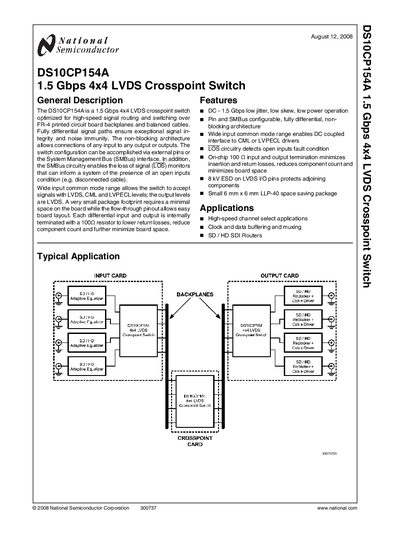
The DS10CP154A is a 1.5 Gbps 4×4 LVDS crosspoint switch designed for high‑speed signal routing. It features a fully differential, non‑blocking architecture with a wide input common‑mode range and on‑chip 1000 Ω termination on each differential I/O.
The device can be configured via external pins or the System Management Bus (SMBus). Detailed pin descriptions, absolute maximum ratings, DC and AC electrical characteristics, and recommended land patterns are provided to aid PCB design and system integration.
| Maximum Data Rate | 1.5 Gbps |
|---|---|
| Channels | 4 × 4 |
| Supply Voltage Range | -0.3 V to +4 V |
| Input/Output Termination | 1000 Ω |
| Typical Supply Current (PWDN=0) | 40 mA (typ) |
| SMBus Enable Pin | EN_smb (pin 17) |
The device supports up to 1.5 Gbps data rate.
Configuration can be done via external pins or through the SMBus interface.
The allowed supply voltage is from –0.3 V to +4 V.
The user‑set SMBus slave address inputs are provided on pins S10/ADDRO, S11/ADDR1, S20/ADDR2, and S21/ADDR3.