
This document describes the features and characteristics of Micron's MT9V125 1/4-Inch VGA SOC Digital Image Sensor, including Micron's DigitalClarity CMOS imaging technology, superior low-light performance, SOC completely integrated camera system, support for adding custom overlay graphics using external devices, etc.
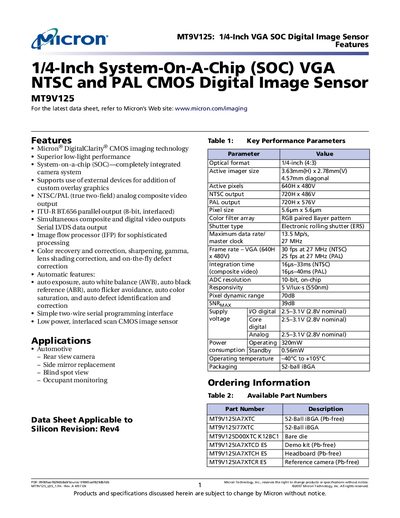
The MT9V125 is a 1/4‑inch VGA system‑on‑chip CMOS image sensor featuring Micron's DigitalClarity technology. It integrates a sensor core, image‑flow processor and video encoder, providing NTSC/PAL analog composite, LVDS and CCIR‑656 digital outputs.
The device operates from a 27 MHz master clock, requires separate analog and digital supplies (2.5‑3.1 V nominal 2.8 V), and supports auto‑exposure, auto‑white‑balance, defect correction and other on‑chip image‑processing functions. It is targeted at automotive rear‑view and side‑mirror cameras, blind‑spot monitoring and occupant monitoring applications.
| Optical format | 1/4-inch (4:3) |
|---|---|
| Active imager size | 3.63 mm × 2.78 mm (4.57 mm diagonal) |
| Active pixels | 640 × 480 |
| Pixel size | 5.6 µm × 5.6 µm |
| Frame rate (NTSC) | 30 fps at 27 MHz |
| Frame rate (PAL) | 25 fps at 27 MHz |
| Supply voltage | 2.5‑3.1 V (2.8 V nominal) |
| Operating temperature | -40 °C to +105 °C |
| Package | 52‑ball iBGA |
A 27 MHz master clock is required to generate correct NTSC or PAL timing.
The sensor includes auto‑exposure, auto‑white‑balance, auto‑black reference, auto flicker avoidance, auto color saturation, defect identification and correction, and on‑the‑fly color correction.