
This document introduces the LTC2484/LTC2484F 24-bit No Latency ∆Σ analog-to-digital converter, which uses patented Easy Drive technology to eliminate dynamic input current errors and the shortcomings of on-chip buffering through automatic cancellation of differential input current.
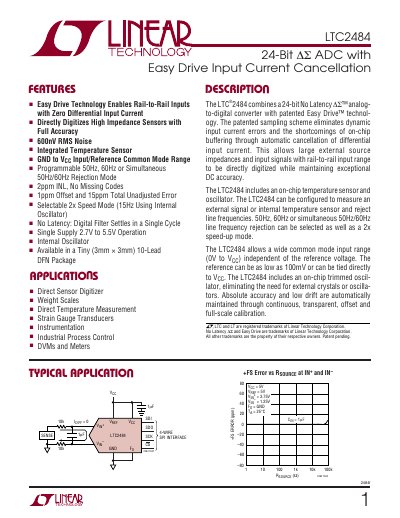
The LTC2484 combines a 24‑bit ΔΣ converter with patented Easy Drive technology that cancels input‑current errors, allowing direct digitization of high‑impedance sensors while maintaining excellent DC accuracy. It features an on‑chip temperature sensor, internal oscillator, and selectable line‑frequency rejection modes (50 Hz, 60 Hz, or simultaneous).
The device operates from a single supply of 2.7 V to 5.5 V, provides 600 nV RMS noise, 2 ppm INL with no missing codes, and a 2× speed mode for up to 15 Hz conversion rate. Typical applications include weight scales, temperature measurement, strain‑gauge transducers, and industrial process control.
| Resolution | 24 bits |
|---|---|
| Supply Voltage | 2.7 V to 5.5 V |
| Input Noise | 600 nV RMS |
| Integral Nonlinearity (INL) | 2 ppm, No Missing Codes |
| Speed Mode | Selectable 2× (15 Hz) speed |
| Integrated Temperature Sensor | Yes |
The device operates from 2.7 V up to 5.5 V.
It can be programmed for 50 Hz, 60 Hz, or simultaneous 50 Hz/60 Hz rejection.
No, the converter provides 24‑bit resolution with no missing codes.
The typical input noise is 600 nV RMS.