
The document provides information about the features and characteristics of the RAE Systems 7HCl sensor, including the normal detection range, maximum detection concentration, sensitivity, baseline current, baseline drift, resolution, response time, linearity, and long-term stability. It also includes information about the operating conditions, physical specifications, and temperature effects of the sensor.
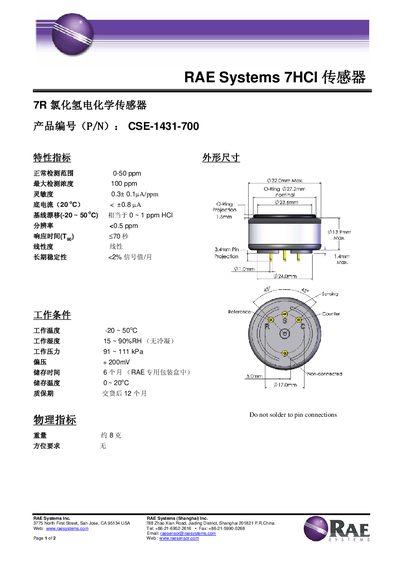
This manual describes the operating environment and physical characteristics of the RAE Systems 7HCI HCl sensor, including temperature, humidity, pressure ranges, and output voltage. It also outlines storage requirements and handling precautions.
Performance graphs illustrate baseline and sensitivity variations with temperature, and the document includes detailed electrical specifications such as drift, cross‑sensitivity, and response time.
| Operating temperature range | -20 to 50 °C |
|---|---|
| Operating humidity range | 15–90 % RH |
| Operating pressure range | 91–111 kPa |
| Output voltage | +200 mV |
| Response time | <70 seconds |
| Sensitivity (current per ppm) | 0.3 + 0.1 µA/ppm |
| Baseline current at 20 °C | <0.8 nA |
| Drift (−20 to 50 °C) | <1 ppm HCl |
| Cross‑sensitivity | <0.5 ppm |
The sensor operates from –20 °C to +50 °C.
The sensor provides a +200 mV output.
The response time is less than 70 seconds.