
The RAE Systems 7HCl-30 sensor is an electrochemical sensor that can measure 0-30 ppm of hydrogen chloride concentration. Its features include detection range, sensitivity, baseline current, baseline drift, resolution, response time, linearity, long-term stability, working conditions, storage time, storage temperature, service life, warranty period, weight, orientation requirements and dimensions.
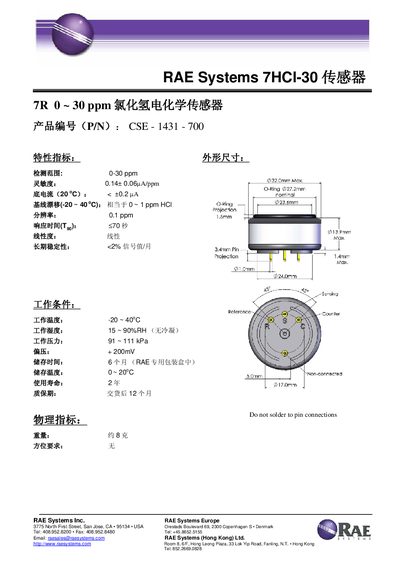
The 7HCI-30 is a handheld sensor designed to detect hydrogen chloride (HCl) gas in concentrations from 0 to 30 ppm. It includes electrical and environmental specifications, safety warnings, and contact information for RAE Systems worldwide.
The manual lists key performance data such as detection range, operating temperature, humidity limits, pressure range, output voltage and current consumption, and provides RAE Systems' global support contacts.
| Detection range | 0 – 30 ppm |
|---|---|
| Operating temperature | -20 – 40 °C |
| Humidity range | 15 – 90 % RH |
| Pressure range | 91 – 111 kPa |
| Output voltage | +200 mV |
| Current consumption | 6 A |
The sensor detects hydrogen chloride from 0 to 30 ppm.
It can operate between –20 °C and 40 °C.
The sensor works in environments with 15 % to 90 % relative humidity.