
ISL9206 is a highly cost-effective fixed-secret hash engine based on Intersil’s second generation FlexiHash™ technology. Device authentication is achieved through a challenge-response scheme customized for low-cost applications, where cloning via eavesdropping without knowledge of the device’s secret code is not economically viable. When used for its intended applications, the ISL9206 offers the same level of effectiveness as other significantly more expensive high-maintenance hash algorithm and authentication schemes. The ISL9206 has a wide operating voltage range, and is suitable for direct powering from a 1-cell Li-Ion/Li-Poly or a 3-cell series NiMH battery pack. The ISL9206 can also be powered by the XSD bus when the bus pull-up voltage is 3.3V or higher. The device connects directly to the cell terminals of a battery pack, and includes on-chip voltage regulation circuit, POR, and a non-crystal based oscillator for bus timing reference. Communication with the host is achieved through a single-wire XSD interface - a light-weight subset of Intersil’s ISD bus interface. The XSD bus is compatible for use with serial ports offered by all 8250 compatible UART’s or a single GPIO (general purpose input and output) pin of a microprocessor. A clone prevention solution utilizing the ISL9206 offers safety and revenue protection at the lowest cost and power, and is suitable for protection against after-market replacement.
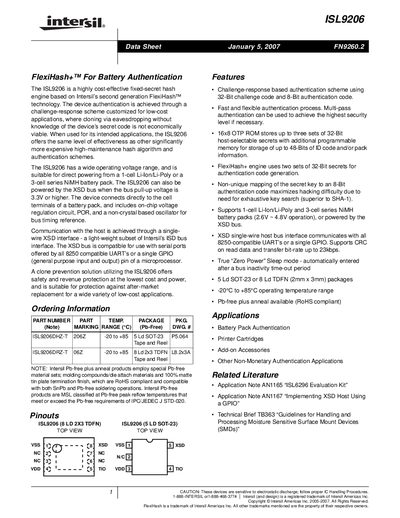
The ISL9206 integrates a FlexiHash+™ 32‑bit hash engine, on‑chip voltage regulation, POR circuit and a non‑crystal oscillator to provide secure, challenge‑response authentication for battery packs. It operates from a 1‑cell Li‑Ion/Li‑Poly or 3‑cell NiMH pack (2.6 V – 4.8 V) or from the XSD bus, and communicates with a host via a single‑wire XSD interface compatible with standard UARTs or a GPIO pin.
Typical applications include battery pack authentication, printer cartridges, add‑on accessories and other low‑cost anti‑counterfeit uses. The device is offered in 5‑lead SOT‑23 or 8‑lead TDFN packages, supports temperatures from –20 °C to +85 °C, and meets RoHS requirements.
| Operating Temperature Range | -20 °C to +85 °C |
|---|---|
| Package Options | 5‑lead SOT‑23 or 8‑lead TDFN (2 mm × 3 mm) |
| OTP ROM Size | 16 Byte (128 bit) |
| XSD Bus Maximum Bit Rate | up to 23 kbps |
It communicates with the host through a single‑wire XSD bus, which can be connected to any 8250‑compatible UART or a single GPIO pin.
The device provides a 16‑byte (128‑bit) OTP ROM for storing secrets, ID code and other data.
The XSD bus can operate at programmable bit rates up to 23 kbps.
The device powers up in Sleep mode and wakes when it receives a ‘break’ command on the XSD bus, after which the internal regulator and POR circuit start.