
The MICRF506 is a true single-chip, frequency shift keying (FSK) transceiver intended for use in half-duplex, bidirectional RF links. The multi-channeled FSK transceiver is intended for UHF radio equipment in compliance with the European Telecommunication Standard Institute (ETSI) specification, EN300 220. The transmitter consists of a PLL frequency synthesizer and power amplifier. The frequency synthesizer consists of a voltage-controlled oscillator (VCO), a crystal oscillator, dual modulus prescaler, programmable frequency dividers, and a phase-detector. The loop-filter is external for flexibility and can be a simple passive circuit. The output power of the power amplifier can be programmed to seven levels. A lock-detect circuit detects when the PLL is in lock. In receive mode, the PLL synthesizer generates the local oscillator (LO) signal. The N, M, and A values that give the LO frequency are stored in the N0, M0, and A0 registers. The receiver is a zero intermediate frequency (IF) type which makes channel filtering possible with low-power, integrated low-pass filters. The receiver consists of a low noise amplifier (LNA) that drives a quadrature mix pair. The mixer outputs feed two identical signal channels in phase quadrature. Each channel includes a pre-amplifier, a third order Sallen-Key RC low-pass filter that protects the following switched-capacitor filter from strong adjacent channel signals, and a
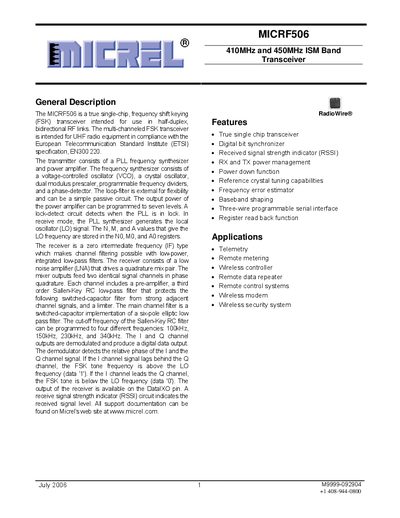
The MICRF506 is a single‑chip FSK transceiver designed for half‑duplex, bidirectional RF links in the 410 MHz to 450 MHz ISM band. It integrates a PLL synthesizer, power amplifier, low‑noise receiver front‑end and an RSSI circuit, and complies with ETSI EN300 220.
The document provides detailed pin descriptions, absolute maximum and operating ratings, electrical characteristics, programming interface timing, and a full set of tables describing mode bits, power‑amplifier settings, and test signals.
| RF Frequency Operating Range | 410 MHz – 450 MHz |
|---|---|
| Power Supply Voltage (operating) | 2.0 V – 2.5 V |
| Operating Temperature Range | -40 °C to +85 °C |
| RSSI Dynamic Range | 50 dB |
The transceiver operates from 410 MHz to 450 MHz.
The device operates with a supply voltage between 2.0 V and 2.5 V.
The device is rated from –40 °C to +85 °C.