
SINEAX DME 440 is a programmable multi-transducer with a RS 485 bus interface (MODBUS®). It supervises several variables of an electrical power system simultaneously and generates 4 proportional analogue output signals. The RS 485 interface enables the user to determine the number of variables to be supervised (up to the maximum available). The levels of all internal energy meters that have been configured (max. 4) can also viewed. Provision is made for programming the SINEAX DME 440 via the bus. A standard EIA 485 interface can be used, but there is no dummy load resistor for the bus. The transducers are also equipped with an RS 232 serial interface to which a PC with the corresponding software can be connected for programming or accessing and executing useful ancillary func- tions. This interface is needed for bus operation to configure the device address, the Baud rate and possibly increasing the telegram waiting time (if the master is too slow) defined in the MODBUS® protocol. The usual methods of connection, the types of measured variables, their ratings, the transfer characteristic for each output and the type of internal energy meter are the main parameters that can be programmed. The ancillary functions include a power system check, provision for displaying the measured values, data storage, system fault diagnosis, serial communication, and external device connection.
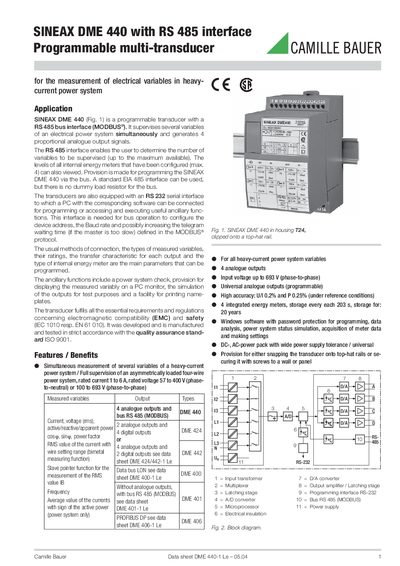
The DME 440 is a programmable transducer designed for heavy‑current power‑system measurement. It can supervise up to four variables simultaneously, provides four proportional analogue outputs, and supports both RS‑485 MODBUS and RS‑232 serial interfaces for configuration and data acquisition.
The device complies with EMC and safety standards (IEC 1010, EN 61010, etc.), offers a wide input voltage range up to 693 V (phase‑to‑phase), and includes four integrated energy meters with a storage life of up to 20 years. Technical data, ordering options, and programming details are provided in the following sections.
| Input voltage range | up to 693 V (phase‑to‑phase) |
|---|---|
| Number of analogue outputs | 4 |
| Accuracy | U/l 0.2 % and P 0.25 % (reference conditions) |
| Power consumption | 9 W (<10 VA) |
The device provides four independent analogue outputs (A, B, C, D).
It can accept input voltages up to 693 V phase‑to‑phase.