
The XR16L2450 is a dual universal asynchronous receiver and transmitter (UART) from Exar Corporation with lower operating voltage and 5 volt tolerant inputs.
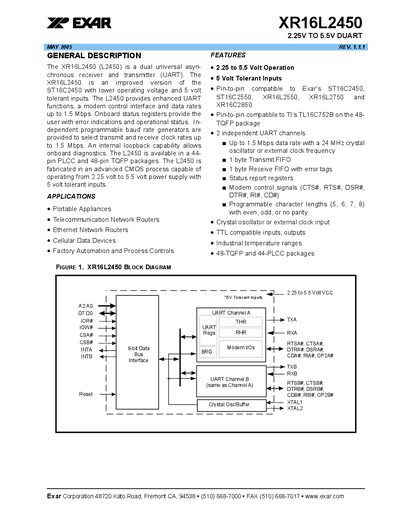
The XR16L2450 is a dual universal asynchronous receiver and transmitter (DUART) that operates from 2.25 V to 5.5 V and provides up to 1.5 Mbps data rates. It is offered in 44‑pin PLCC and 48‑pin TQFP packages and includes modem‑control signals, programmable baud‑rate generators, and internal loopback for diagnostics.
The document contains a functional description, CPU interface details, pin‑out assignments, electrical characteristics, and ordering information. It also explains device reset, identification codes, channel selection, and timing diagrams for both transmitter and receiver functions.
| Operating Voltage | 2.25 V to 5.5 V |
|---|---|
| Input Tolerance | 5 V tolerant inputs |
| Maximum Data Rate | 1.5 Mbps |
| UART Channels | 2 independent channels |
| Package Types | 44‑pin PLCC, 48‑pin TQFP |
| Operating Temperature Range | -40 °C to +85 °C |
| Transmit FIFO Depth | 1 byte |
| Receive FIFO Depth | 1 byte with error tags |
It operates from 2.25 V to 5.5 V.
The device provides two independent UART channels.
The maximum data rate is up to 1.5 Mbps.
Yes, all inputs are 5 V tolerant.