
ST16C450 is a high-performance asynchronous receiver and transmitter chip produced by EXAR company, which has better performance than NS16450 UART and has higher operating speed and lower access time.
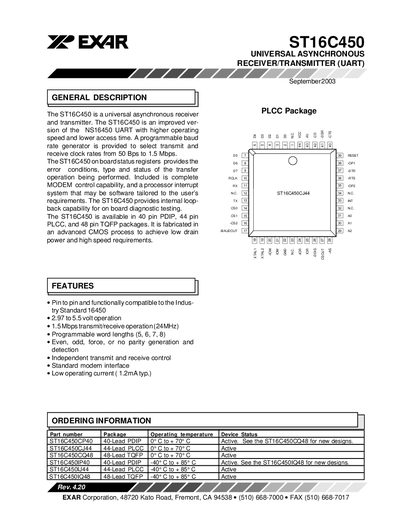
The EXAR ST16C450 is a universal asynchronous receiver/transmitter (UART) that offers higher operating speed and lower access time than the classic 16450. It includes a programmable baud‑rate generator covering 50 Bps to 1.5 Mbps, internal loop‑back for diagnostics, and full modem‑control capabilities.
The device is supplied in 40‑lead PDIP, 44‑lead PLCC and 48‑lead TQFP packages, operates from 2.97 V to 5.5 V, and draws a typical 1.2 mA current. Detailed pin functions, internal registers, and package dimensions are provided for hardware designers.
| Operating voltage | 2.97 V to 5.5 V |
|---|---|
| Maximum data rate | 1.5 Mbps |
| Typical operating current | 1.2 mA |
| Package options | 40‑lead PDIP, 44‑lead PLCC, 48‑lead TQFP |
| Operating temperature (standard grades) | 0 °C to +70 °C |
| Baud‑rate generator range | 50 Bps to 1.5 Mbps |
The ST16C450 supports up to 1.5 Mbps transmit and receive operation.
It operates from 2.97 V to 5.5 V.
The device is available in 40‑lead PDIP, 44‑lead PLCC, and 48‑lead TQFP packages.
Typical current consumption is about 1.2 mA.