
The AD526 is a single-ended, monolithic software programmable gain amplifier (SPGA) that provides gains of 1, 2, 4, 8, and 16. It is complete, including amplifier, resistor network, and TTL-compatible latched inputs, and requires no external components. Low gain error and low nonlinearity make the AD526 ideal for precision instrumentation applications requiring programmable gain. The small signal bandwidth is 350 kHz at a gain of 16. In addition, the AD526 provides excellent dc precision. The FET-input stage results in a low bias current of 50 pA.
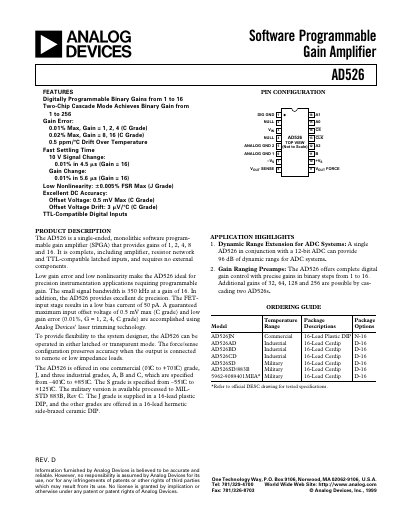
The AD526 is a single‑ended, monolithic software programmable gain amplifier offering binary gains of 1, 2, 4, 8 and 16, with a two‑chip cascade mode extending the range to 256. It integrates an amplifier, resistor network and TTL‑compatible latched inputs, requiring no external components and delivering low gain error and low non‑linearity for precision instrumentation.
This handbook provides a complete description of the device, including pin configuration, ordering options, performance specifications, theory of operation, transparent and latched modes, timing requirements, grounding and bypass techniques, cascaded operation, offset nulling methods, and examples of floating‑point A/D converter applications.
| Gain range (binary) | 1 to 16 (single) / 1 to 256 (cascade) |
|---|---|
| Gain error (C Grade) | 0.01% max at gains 1,2,4 |
| Input bias current | 50 pA |
| Output voltage swing | ±6 V |
The AD526 offers digitally programmable binary gains of 1, 2, 4, 8 and 16, and two‑chip cascade mode can extend the gain range up to 256.
The device has a very low input bias current of about 50 pA.
In transparent mode, the AD526 responds directly to level changes at the gain code inputs when B is high and both CS and CLK are allowed to float low.
Yes, two AD526 devices can be cascaded to achieve binary gains from 1 to 256.