
The AD8203 is a single-supply difference amplifier for amplifying and low-pass filtering small differential voltages in the presence of a large common-mode voltage (CMV). The input CMV range extends from -6 V to +30 V at a typical supply voltage of 5 V. The AD8203 is available in die and packaged for use in a variety of applications, such as transmission control, diesel injection control, engine management, adaptive suspension control, and vehicle dynamics control.
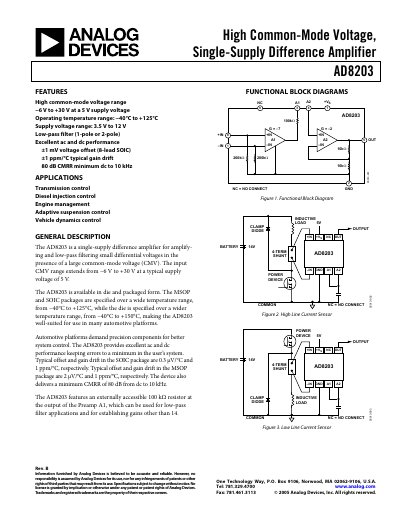
The AD8203 is a single‑supply difference amplifier designed for amplifying and low‑pass filtering small differential voltages in the presence of a large common‑mode voltage. It operates over a wide temperature range and offers high common‑mode voltage capability, making it suitable for automotive applications such as transmission control and engine management.
The document provides detailed specifications, functional block diagrams, pin descriptions, performance characteristics, and ordering information for both SOIC and MSOP packages.
| Supply voltage range | 3.5 V to 12 V |
|---|---|
| Operating temperature range (SOIC) | -40°C to +125°C |
| Common‑mode voltage range | -6 V to +30 V |
| Voltage offset | ±1 mV |
The AD8203 operates with a supply voltage from 3.5 V to 12 V.
It supports a common‑mode voltage range of –6 V to +30 V.