
The SP6139 is a synchronous step-down switching regulator controller optimized for high efficiency. The part is designed to be especially attractive for dual supply, 12V step down with 5V used to power the controller. This lower VCC voltage minimizes power dissipation in the part.
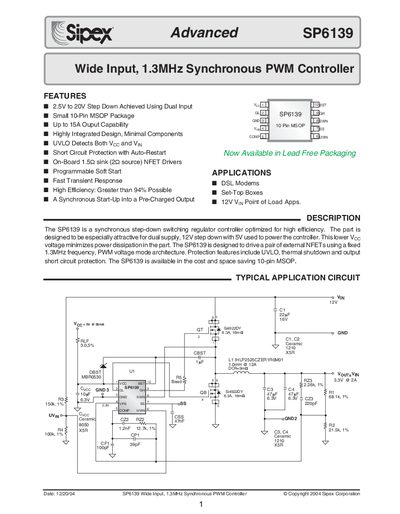
The SP6139 is a synchronous step‑down switching regulator controller optimized for high efficiency. It operates from 2.5 V to 20 V input, provides up to 15 A output, and includes UVLO, thermal shutdown and short‑circuit protection. The device is supplied in a compact 10‑pin MSOP package and is intended for applications such as DSL modems, set‑top boxes and other high‑efficiency power supplies.
The datasheet details electrical characteristics, pin functions, typical application circuits, component selection guidelines for inductors and capacitors, and ordering information. It also includes absolute maximum ratings, functional diagrams, and a full list of specifications for designers.
| Input voltage range | 2.5 V to 20 V |
|---|---|
| Thermal shutdown temperature | 145 °C |
| Maximum duty ratio | 100 % |
| Package type | 10‑pin MSOP |
It operates from 2.5 V to 20 V input.
Thermal shutdown occurs at 145 °C.
The device is supplied in a 10‑pin MSOP package.