
TLE 6252 G is a fault tolerant differential CAN transceiver optimized for low-speed data transmission (up to 125 kBaud) in automotive and industrial applications. The device supports 125 kBaud data transmission, and automatically switches to single-wire mode to maintain communication when bus wiring failures are detected. While no data is transferred, the power consumption can be minimized by multiple low power modes.
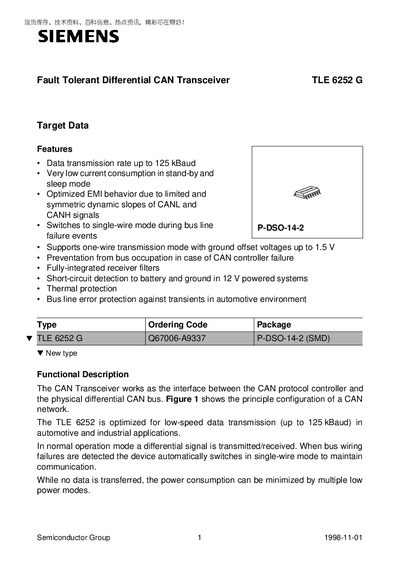
This manual describes the Siemens TLE 6252G fault‑tolerant differential CAN transceiver. It lists key features such as a data transmission rate up to 125 kBaud, very low standby current, EMI‑optimized signaling, and automatic switch‑over to single‑wire mode on bus failures. The device includes integrated receiver filters, short‑circuit detection, thermal protection, and bus line error protection for automotive environments.
The document provides a functional description, pin configuration and definitions, a functional block diagram, and details of the three low‑power operation modes (sleep, stand‑by, and Voc stand‑by). Truth tables and state diagrams illustrate mode transitions, and the package outline (P‑DSO‑14‑2) with dimensions is given for PCB layout.
| Data transmission rate | up to 125 kBaud |
|---|---|
| Supply voltage | +5 V |
| Battery voltage | +12 V |
The transceiver supports a data transmission rate of up to 125 kBaud.