
The MAX7377 is a dual-speed silicon oscillator with reset that is a replacement for ceramic resonators, crystals, crystal oscillator modules, and discrete reset circuits. The device provides the primary and secondary clock source for microcontrollers in 3V, 3.3V, and 5V applications. The MAX7377 features a factory-programmed high-speed oscillator, a 32.768kHz oscillator, and a clock selector input. The clock output can be switched at any time between the high-speed clock and the 32.768kHz clock for low-power operation. Switchover is synchronized internally to provide glitch-free clock switching. Unlike typical crystal and ceramic resonator oscillator circuits, the MAX7377 is resistant to vibration and EMI. The high-output-drive current and absence of high- impedance nodes make the oscillator less susceptible to dirty or humid operating conditions. With a wide operating temperature range as standard, the MAX7377 is a good choice for demanding home appliance, industrial, and automotive environments. The MAX7377 is available in factory-programmed frequencies from 32.768kHz to 10MHz. See Table 1 for standard frequencies and contact the factory for custom frequencies. The MAX7377 is available in a 5-pin SOT23 package. Refer to the MAX7383 data sheet for frequencies ≥10MHz. The MAX7377 standard operating tempera- ture range is -40°C to +125°C. See the Applications Information section for the extended operating temper- ature range.
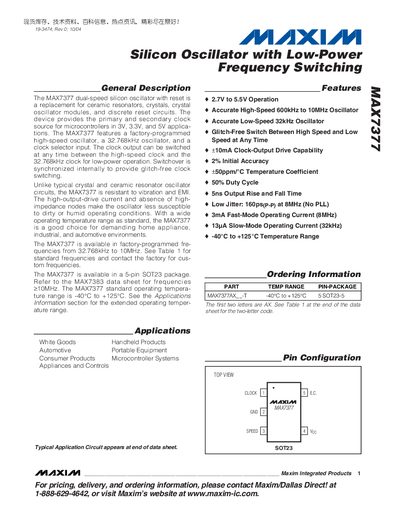
The MAX7377 dual‑speed silicon oscillator provides both a high‑speed clock (600 kHz to 10 MHz) and a low‑speed 32.768 kHz clock in a single 5‑pin SOT‑23 package. It replaces ceramic resonators, crystals, and external reset circuits, delivering robust performance in home‑appliance, industrial, and automotive environments.
Key features include a wide supply range (2.7 V‑5.5 V), +10 mA output drive, low jitter (160 ps p‑p at 8 MHz), and glitch‑free clock switching via the SPEED pin. The device operates from –40 °C to +125 °C (tested to +135 °C) and offers factory‑programmed frequencies from 32.768 kHz to 10 MHz.
| Supply Voltage Range | 2.7 V to 5.5 V |
|---|---|
| High‑Speed Frequency Range | 600 kHz to 10 MHz |
| Low‑Speed Frequency | 32.768 kHz |
| Clock Output Drive Capability | +10 mA |
| Temperature Coefficient | +50 ppm/°C |
| Duty Cycle | 50 % |
| Output Rise/Fall Time | 5 ns |
| Output Jitter (8 MHz) | 160 ps p‑p |
| Operating Temperature Range | -40 °C to +125 °C |
The device is specified for –40 °C to +125 °C, and it has been tested to operate up to +135 °C.
Clock speed is selected with the SPEED pin: pulling it low selects the 32.768 kHz low‑speed clock, pulling it high selects the high‑speed clock.
The MAX7377 can drive up to +10 mA on its clock output.
It operates with supply voltages from 2.7 V to 5.5 V.