
The TLP651 is a photocoupler from Toshiba. It has high isolation voltage, fast switching speed and other characteristics. It can be widely used in digital logic, ground isolation, line receiver, microprocessor system interfaces, switching power supply, feedback control, analog signal isolation and other fields.
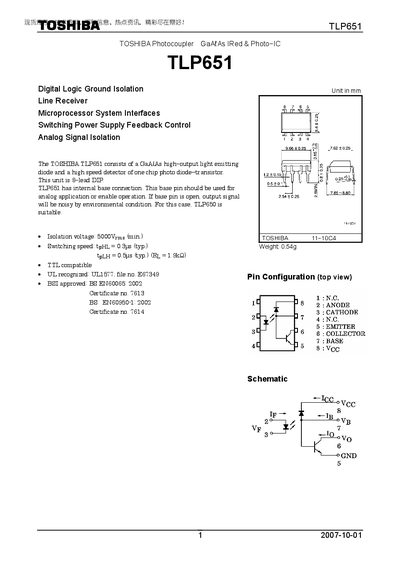
The TLP651 is a GaAs infrared photocoupler that combines a high‑output LED with a fast detector in a single 8‑lead DIP package. It is designed for digital logic ground isolation, line‑receiver functions, and analog signal isolation in microprocessor and switching‑power applications.
Key specifications include a minimum isolation voltage of 5000 V, typical propagation delay of 0.3 µs, forward current rating of 25 mA, and an output current capability of 8 mA. The device is UL‑1577 and BS EN60065 certified and is intended for general electronics use while prohibiting high‑risk applications such as aerospace or medical equipment.
| Isolation voltage (min) | 5000 V |
|---|---|
| Forward current (IF) | 25 mA |
| Pulse forward current (IFp) | 50 mA |
| Output current (lo) | 8 mA |
| Propagation delay (tpHL, typ.) | 0.3 µs |
| Weight | 0.54 g |
| Package | 8‑lead DIP |
The device provides a minimum isolation voltage of 5000 V.
The continuous forward current (IF) is rated at 25 mA.
The pulse forward current (IFp) can reach up to 50 mA.