
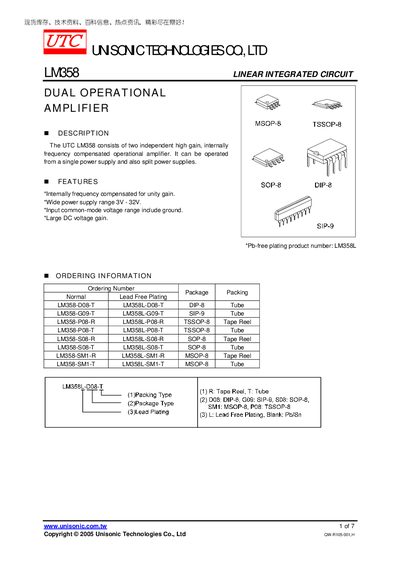
The LM358 is a dual, high‑gain, internally frequency‑compensated operational amplifier that can operate from a single or split power supply. It offers a wide supply voltage range, ground‑referenced input common‑mode range, and large DC voltage gain.
The device is offered in multiple packages (DIP‑8, SIP‑9, SOP‑8, MSOP‑8, TSSOP‑8) with lead‑free plating options. Absolute maximum ratings include up to 32 V supply, operating temperature from 0 °C to 70 °C, and a junction temperature limit of 125 °C. Detailed electrical characteristics such as input offset voltage, bias currents, and output drive capabilities are listed.
| Supply voltage range | 3 V – 32 V |
|---|---|
| Input common‑mode voltage range | Includes ground |
| Large DC voltage gain | High |
| Maximum supply voltage (absolute rating) | +16 V or +32 V |
| Operating temperature range | 0 °C to 70 °C |
| Junction temperature limit | +125 °C |
| Output short‑circuit current (SIP‑9) | 600 mA |
| Output short‑circuit current (DIP‑8) | 500 mA |
The LM358 operates from 3 V up to 32 V.
The LM358 is offered in DIP‑8, SIP‑9, SOP‑8, MSOP‑8, and TSSOP‑8 packages, with lead‑free or standard plating.
The input common‑mode voltage range includes ground.
The device can tolerate up to +16 V or +32 V supply voltage.