
The AT27C2048 is a low-power, high-performance 2,097,152-bit one-time program-mable read-only memory (OTP EPROM) organized 128K by 16 bits. It requires a single 5V power supply in normal read mode operation. Any word can be accessed in less than 55 ns, eliminating the need for speed-reducing WAIT states. The by-16 organization makes this part ideal for high-performance 16 and 32 bit microprocessor systems. In read mode, the AT27C2048 typically consumes 15 mA. Standby mode supply cur-rent is typically less than 10 µA. The AT27C2048 is available in industry-standard JEDEC-approved one-time pro-grammable (OTP) plastic PDIP, PLCC, and VSOP packages. The device features two-line control (CE, OE) to eliminate bus contention in high-speed systems. With high density 128K word storage capability, the AT27C2048 allows firmware to be stored reliably and to be accessed by the system without the delays of mass storage media.
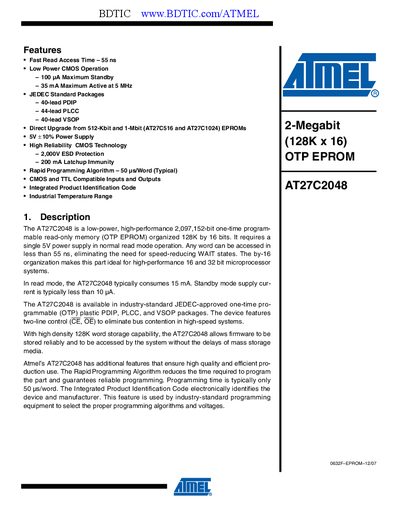
The AT27C2048 is a low‑power, high‑performance 2,097,152‑bit (128K × 16) one‑time programmable read‑only memory that operates from a single 5 V supply. It offers fast read access (55 ns) and low standby current, making it suitable for high‑speed 16‑ and 32‑bit microprocessor systems.
The document details pin assignments for PDIP, PLCC, and VSOP packages, electrical limits, timing diagrams, and programming procedures, including the rapid programming algorithm (≈50 µs per word) and the integrated product identification code.
| Read Access Time | 55 ns |
|---|---|
| Standby Current | 100 pA (maximum) |
| Active Current at 5 MHz | 35 mA (maximum) |
| Supply Voltage | 5 V ±10 % |
| ESD Protection | 2000 V |
| Latchup Immunity | 200 mA |
| Programming Time | ≈50 µs per word |
| Memory Size | 2,097,152 bits (128K × 16) |
| Operating Temperature Range | -55 °C to +125 °C |
| Package Types | 40‑lead PDIP, 44‑lead PLCC, 40‑lead VSOP |
The device provides a fast read access time of 55 ns.
The AT27C2048 operates from a single 5 V supply with a ±10 % tolerance.
Standby current is limited to a maximum of 100 pA.
Programming typically takes about 50 µs per word using the rapid programming algorithm.