
This document mainly introduces the features and characteristics of ATmega48PB microcontroller, including high performance, low power, advanced RISC architecture, non-volatile program and data storage, on-chip debugging and battery management functions.
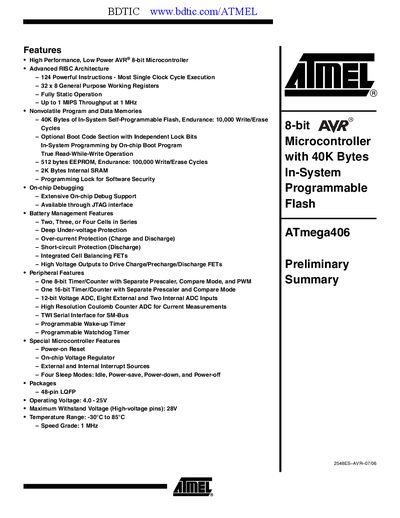
The ATmega406 is a low‑power CMOS 8‑bit microcontroller based on Atmel's AVR enhanced RISC architecture. It offers up to 1 MIPS throughput at 1 MHz, integrated voltage regulation, battery‑protection circuitry, and high‑voltage I/O for Li‑ion smart‑battery applications.
The document provides a complete overview of the device, including block diagrams, pin‑out diagrams, detailed pin descriptions, port functions, register summaries, and revision history. It also lists electrical characteristics, timing specifications, and development‑tool support.
| Operating Voltage | 4.0 - 25 V |
|---|---|
| Maximum Withstand Voltage (high‑voltage pins) | 28 V |
| Temperature Range | -30 °C to 85 °C |
| Flash Memory | 40 KB In‑System Self‑Programmable Flash |
| EEPROM | 512 bytes |
| SRAM | 2 KB |
| General‑purpose Working Registers | 32 |
| Package | 48‑pin LQFP |
The ATmega406 operates from 4.0 V up to 25 V.
It includes 40 KB of In‑System Self‑Programmable Flash memory.
It features a 12‑bit Sigma‑Delta ADC dedicated to Coulomb counting for fuel‑gauging.
The device is offered in a 48‑pin LQFP package.