
ADV7188 Rev. A is an Analog Devices multi-format SDTV video decoder that supports fast switch overlay support
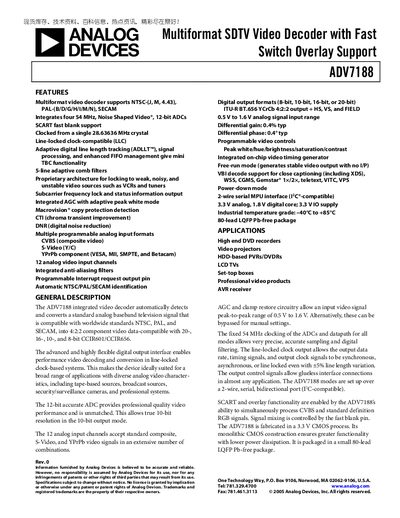
The ADV7188 is a single‑chip multiformat video decoder that automatically detects and converts NTSC, PAL, and SECAM analog video signals (composite, S‑Video, and component) into digital ITU‑R BT.656 4:2:2 output. It integrates four 12‑bit noise‑shaped video ADCs, a 5‑line adaptive comb filter, and supports SCART fast‑blank and overlay functions.
The device offers a flexible 2‑wire I²C‑compatible serial interface for register programming, provides extensive VBI data services, and operates over an industrial temperature range of –40 °C to +85 °C. Electrical, timing, and thermal specifications are detailed for system designers.
| Resolution (Each ADC) | 12 Bits |
|---|---|
| Differential Gain | 0.4 % typ |
| Operating Temperature Range | -40 °C to +85 °C |
| Nominal System Clock Frequency | 28.63636 MHz |
| Analog Input Signal Range | 0.5 V to 1.6 V |
It supports NTSC (J, M, 4.43), PAL (B/D/G/H/I/M/N) and SECAM standards in composite, S‑Video, and component formats.
The analog core operates from 3.15 V to 3.45 V.
Registers are programmed via a 2‑wire serial I²C‑compatible MPU interface.
The junction‑to‑ambient thermal resistance is 38.1 °C/W on a 4‑layer PCB with solid ground plane.