
The AD9114/AD9115/AD9116/AD9117 are dual low power 8-/10-/12-/14-bit TxDAC digital-to-analog converters with adjustable output common mode and small footprint.
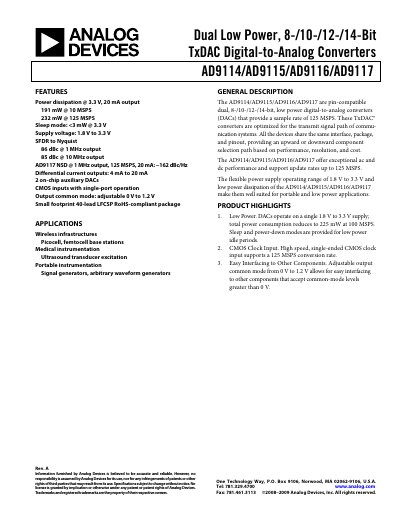
The AD9116 is a low‑power, 14‑bit dual‑channel digital‑to‑analog converter (DAC) that operates from a single 1.8 V to 3.3 V supply and delivers up to 125 MSPS sample rate. It offers low power dissipation (191 mW @ 10 MSPS) and features adjustable output common‑mode, on‑chip auxiliary DACs, and CMOS clock input.
The handbook covers features, applications such as wireless infrastructure and medical instrumentation, functional block diagrams, detailed DC, AC, and digital specifications, pin configurations, SPI interface details, and typical performance characteristics. Revision history and ordering information are also included.
| Resolution | 14 bits |
|---|---|
| Supply voltage range | 1.8 V to 3.3 V |
| Maximum sample rate | 125 MSPS |
| Power dissipation @ 10 MSPS | 191 mW |
| Spurious‑free dynamic range (SFDR) at 1 MHz | 86 dBc |
The device operates from 1.8 V up to 3.3 V.
It can sample at up to 125 MSPS.
Power dissipation is 191 mW at 10 MSPS.
The spurious‑free dynamic range is 86 dBc at 1 MHz.