
The AD7822/AD7825/AD7829 are high speed, 1-, 4-, and 8-channel, microprocessor-compatible, 8-bit analog-to-digital converters.
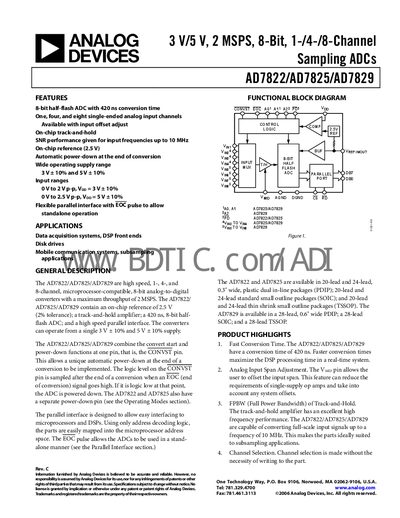
The AD7825 is an 8‑bit half‑flash analog‑to‑digital converter with a 420 ns conversion time and up to 2 MSPS throughput. It offers one, four, or eight single‑ended input channels, on‑chip reference, track‑and‑hold, and a flexible parallel interface with an end‑of‑conversion pulse for standalone operation.
The device operates from a single 3 V ±10% or 5 V ±10% supply, includes automatic power‑down, and is available in PDIP, SOIC, and TSSOP packages. Detailed specifications cover dynamic performance, power consumption, absolute maximum ratings, and pin functions.
| Resolution | 8 Bits |
|---|---|
| Conversion Time | 420 ns max |
| Maximum Throughput | 2 MSPS |
| Supply Voltage | 3 V ±10% or 5 V ±10% |
| On‑chip Reference | 2.5 V |
| Signal‑to‑Noise Ratio | 48 dB min |
| Total Harmonic Distortion | -55 dB max |
| Power Consumption (Normal Operation) | 12 mA max |
| Power‑down Current | 5 pA max |
The AD7825 has a conversion time of 420 ns maximum.
It can be powered from a single 3 V ±10% or 5 V ±10% supply.
The on‑chip reference provides a nominal 2.5 V output.
The AD7825 offers four single‑ended analog input channels.