
The Cut Disk Structure (CDS) has been proposed for high energy linacs as an accelerating structure with high coupling coefficient. This structure was studied for applications both in proton and electron linear accelerators. An important point for the stable structure operation is a cool- ing capability. Real 3D thermal stress analysis has been performed by coupled simulations with MAFIA and AN- SYS codes. For this purpose a special interface code was developed. The temperature and thermal stress distribu- tions, operating and coupling modes frequency shifts for different operating regimes and coolingschemes were stud- ied. Results of the study are presented. For moderate and high heat loading the drift tube region is necessary. Spe- cial coupling windows shape is proposed to simplify CDS cooling for operation with high (more than 15 kW/m) heat loading.
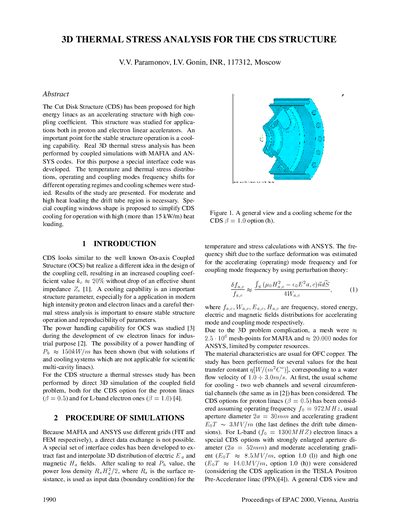
This document presents a 3D thermal stress analysis of the Cut Disk Structure (CDS), developed by INR for high-energy linear accelerators. It details thermal stress distributions, cooling requirements, and frequency shifts under various operating regimes. The analysis uses coupled simulations with MAFIA and ANSYS codes, with special interface codes for data exchange. The CDS is designed for both proton and electron linacs, with cooling schemes optimized for moderate to high heat loading. Results show that web cooling is necessary for high heat loads, and internal stresses remain below copper’s yield strength.
| Material | OFC copper |
|---|---|
| Operating Frequency (Proton Linacs) | 299.79 MHz |
| Accelerating Gradient (Proton Linacs) | 10 MV/m |
| Heat Load Threshold for Web Cooling | 15 kW/m |
| Maximum Overheating Value | 19.76°C |
The CDS structure is designed for high-energy linear accelerators, specifically for proton and electron linacs, to achieve high coupling coefficient without reducing effective shunt impedance.
For high heat loading (more than 15 kW/m), a special coupling window shape is proposed to simplify cooling, and web cooling is necessary.
The maximum overheating value is 19.76°C for a heat load of 10 kW/m and a cooling constant of 0.5.
The material used is OFC copper, with typical characteristics for thermal and mechanical properties.