
Brocade 300 switch is an easy-to-use entry-level SAN switch that provides small businesses with scalable, highly available and reliable SAN connectivity. 8-port, 16-port and 24-port configurations meet a variety of deployment needs. With auto-sensing 1, 2, 4 and 8 Gbit/sec throughput and native operation with Brocade and Brocade M-series fabric architectures, it protects existing investments.
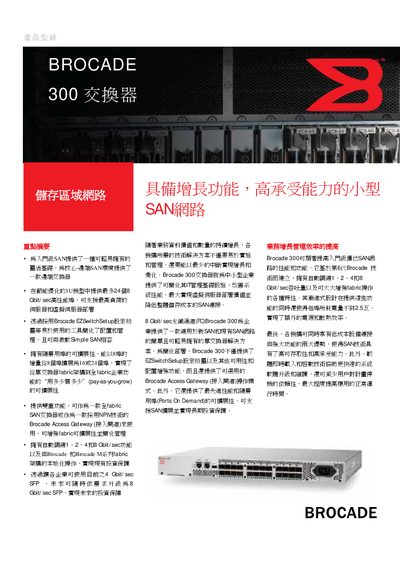
The Brocade 300 is a 1U fiber SAN switch offering 8 Gbit/sec and 4 Gbit/sec SFP ports, supporting advanced features such as NPIV, Ports On Demand, and ISL trunking. It is designed for enterprise storage networks and can be managed via Brocade Fabric Manager, web tools, and CLI.
This manual covers hardware installation, cabling, initial configuration, management interfaces (Telnet, HTTP, SNMP), fabric settings, and environmental specifications. It also includes troubleshooting guidance and regulatory information. This manual is written in Chinese.
| Port speed (SFP) | 8 Gbit/sec |
|---|---|
| Port speed (SFP+) | 4 Gbit/sec |
| Maximum fabric bandwidth | 408 Gbit/sec |
| ISL trunking bandwidth | 68 Gbit/sec |
| Operating temperature | –25 °C to 70 °C |
| Power consumption | 195 BTU/hr |
The switch provides up to 408 Gbit/sec of fabric bandwidth.
The device operates from –25 °C up to 70 °C.