
AD830 is a high speed video difference amplifier, with wide common-mode voltage range, high differential gain, high CMRR, fast dynamic performance, excellent video specifications and flexible operation.
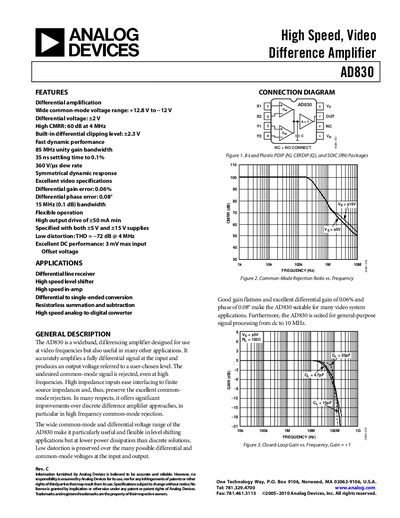
The AD830 is a wideband differential amplifier designed for video‑frequency applications. It provides accurate amplification of fully differential signals while rejecting common‑mode noise, offering a wide common‑mode voltage range (+12.8 V to –12 V) and high output drive capability (+50 mA minimum). The device features a 85 MHz unity‑gain bandwidth, 360 V/µs slew rate, and low total harmonic distortion (‑72 dB at 4 MHz).
The datasheet includes detailed electrical specifications, absolute maximum ratings, thermal resistance data, and an ordering guide for the AD830J, AD830A, and AD830S variants. It also provides typical performance graphs such as common‑mode rejection versus frequency and power‑supply rejection ratios.
| Small‑Signal Bandwidth (3 dB) | 85 MHz (typ) |
|---|---|
| Slew Rate | 360 V/µs (typ) |
| Output Current | 50 mA (typ) |
| Common‑Mode Voltage Range | +12.8 V to –12 V |
The AD830 has a typical 3 dB small‑signal bandwidth of 85 MHz.
The device can source a typical output current of 50 mA.
It accepts common‑mode voltages from +12.8 V down to –12 V.