
This document describes the features and characteristics of the CS-3254 series products, and provides instructions for use and possible changes in appearance and specifications.
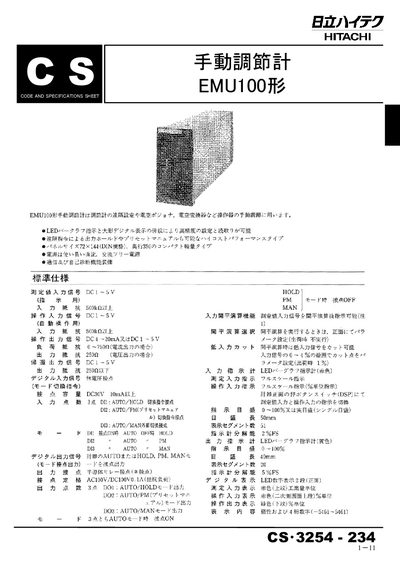
The EMU100 is a manual adjustment controller designed for precise setting and read‑out of process variables. It features a combined LED bar‑graph and large digital display, offering high‑resolution indication and optional output hold or preset functions.
The manual covers panel dimensions, power requirements, input/output signal types, communication options (including RS‑485/RS‑422), operation modes (AUTO, HOLD, PM, MAN), wiring diagrams, and parameter settings. Safety and installation notes are also included. This manual is written in Japanese.
| Panel size | 72 × 144 mm (DIN) |
|---|---|
| Power supply (AC) | 85‑138 V / 170‑264 V, 10 VA |
| Maximum output current | 20 mA |
| Digital communication | RS‑485 / RS‑422 optional |
The EMU100 can be powered from AC 85‑138 V or 170‑264 V (10 VA) or from a DC source of 1‑5 V.
It supports digital serial transmission via current loop or shielded twisted‑pair at 19.2 kBps, and optional RS‑485 or RS‑422 interfaces.
The device offers AUTO, HOLD, PM (preset manual) and MAN modes, selectable with front‑panel switches.