
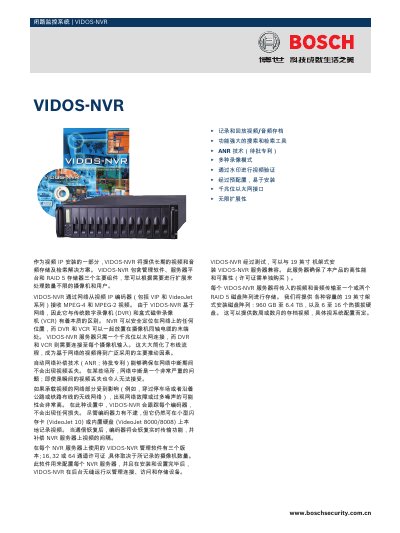
This Bosch leaflet describes the VIDOS-NVR, a network-based video recording and retrieval system for closed-circuit monitoring. The system consists of three main components: the management software, a server platform and RAID 5 storage. It receives MPEG-4 and MPEG-2 video over the network from video IP encoders, including the VIP and VideoJet series, and it can be expanded to handle an unlimited number of cameras and users.
The document covers the main features, such as ANR (Automatic Network Replenishment, patent pending), which keeps video from being lost during network interruptions, video verification by watermark, and simultaneous recording, playback and backup. It also lists what is supplied, the system requirements for the PC, the software functions, the technical data, and the ordering information for the 16, 32 and 64 channel licenses, upgrade codes and hardware accessories. This manual is written in Chinese.
| CPU | Pentium III Xeon or IV, 1.8 GHz or faster |
|---|---|
| RAM | 1024 MB |
| Operating system | Windows 2000 32-bit, Windows Server 2003 32-bit |
| Hard disk interface | IDE or better; optional SCSI II, SCSI Ultra or Fibre Channel |
| Ethernet card | 100/1000 MBit |
| Storage modes | Linear mode or circular mode (capacity-based) |
| RAID 5 disk array capacity | 960 GB to 6.4 TB, with 6 to 16 hot-swappable hard disks |
| Management software licenses | 16, 32 or 64 channel licenses |
The management software is offered in 16, 32 or 64 channel licenses, depending on the number of recorded cameras.
It receives MPEG-4 and MPEG-2 video over the network from video IP encoders, including the VIP and VideoJet series.
The automatic network replenishment technology (ANR, patent pending) tracks each encoder so that no video is lost, and the gap is filled on the NVR server once communication is restored.
Windows 2000 32-bit or Windows Server 2003 32-bit.