
Ideal for collaboration, file sharing, and data protection, the T110 II is an ideal first server for small businesses.
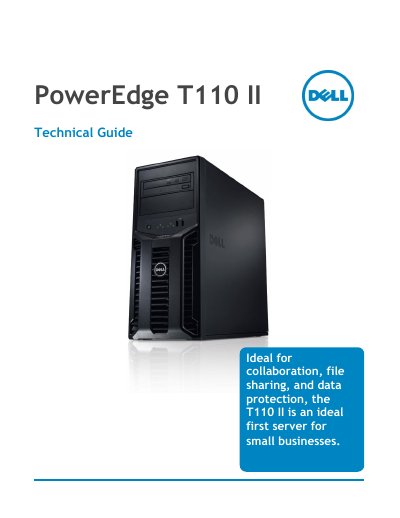
The Dell PowerEdge T110 II is a powerful and reliable tower form factor server designed as an ideal first server for small businesses. It supports desktop consolidation, file sharing, printer sharing, and data protection needs while offering straightforward systems management.
This document provides detailed technical information including product comparisons with predecessors (T110) and competitors (T310), new technologies like Intel Xeon E3-1200 processors, system specifications for memory, storage, and power supplies, as well as mechanical descriptions and environmental requirements.
| Form Factor | Tower form factor |
|---|---|
| Processor Family (T110 II) | Intel Xeon processor E3-1200 product family |
| Processor Family (T110) | Quad-core Intel Xeon processor 3400 series |
| Memory Type | DDR3 Unbuffered with ECC 1333/1066MHz |
It is an ideal first server for small businesses considering or implementing desktop consolidation, file sharing, printer sharing or wishing to reduce software licensing charges.
The T110 II uses Intel Xeon E3-1200 or Core i3-2100 processors and supports up to 32GB RAM, whereas the T310 uses Pentium/Core i3 processors with similar specs but different processor families.