
Key facts
- Brand
- ZORBAX
- Model
- SB-C8
- Documents
- 2
- Languages
- EN
- Last added
- 2012-07-03
Start here
ZORBAX SB-C8 (3.5 m 5 m) (4.6 x 150 mm) (P/N:863953.906 883975.906)
This document is a product leaflet for the Hewlett-Packard ZORBAX SB-C8 column, specifically the 3.5 µm and 5 µm silica versions with dimensions of 4.6 x 150 mm. It includes part numbers 863953.906 and 883975.906.
Read onlineZORBAX SB-C8 specifications
| Column Dimensions | 4.6 x 150 mm |
|---|---|
| Part Numbers | 863953.906 and 883975.906 |
| Material | Silica |
Source: ZORBAX SB-C8 (3.5 m 5 m) (4.6 x 150 mm) (P/N:863953.906 883975.906)
All ZORBAX SB-C8 documents by type
Questions answered in these manuals
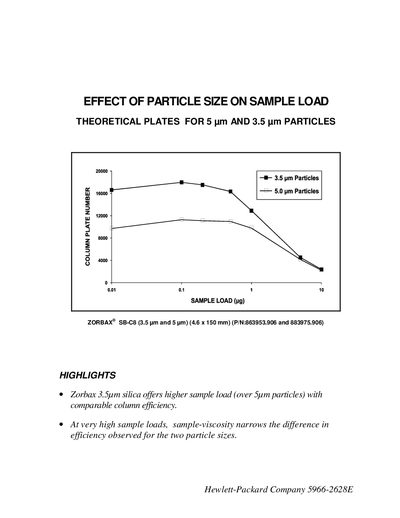
What is the advantage of 3.5 µm particles over 5 µm particles?
3.5 µm particles offer higher sample load with comparable column efficiency.
From: ZORBAX SB-C8 (3.5 m 5 m) (4.6 x 150 mm) (P/N:863953.906 883975.906)
How does sample load affect efficiency at high loads?
At very high sample loads, sample-viscosity narrows the difference in efficiency observed for the two particle sizes.
From: ZORBAX SB-C8 (3.5 m 5 m) (4.6 x 150 mm) (P/N:863953.906 883975.906)
What is the benefit of using short, small-particle columns?
They enable high-speed, high-resolution separation of a herbicide mixture in less than 8 minutes.
How does the 3.5 µm particle size compare to 5 µm particles?
Smaller particle size (3.5m) leads to separations of similar efficiency when compared to 5um particles in columns of twice the length.