
Key facts
- Brand
- SINO
- Model
- SH69P26
- Industry
- Industrial
- Documents
- 2
- Languages
- EN · ZH
- Last added
- 2012-04-02
Start here
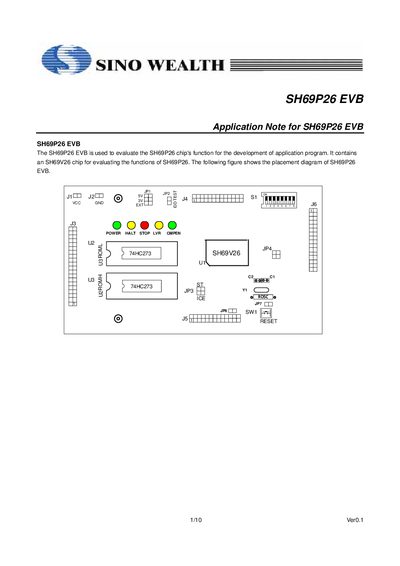
SINO WEALTH SH69P26 EVB Application Note
This document provides an overview of the SH69P26 Evaluation Board (EVB) used to evaluate the SH69P26 microcontroller. It explains the two operating modes – ICE mode, where the board connects to a mother‑board, and stand‑alone mode, where the program is stored in Flash or EPROM.
Detailed sections cover the interface connectors, switch and jumper settings, LED indicators, and programming guidelines using the Rice66 IDE. Notes on interrupt handling, timer configuration, and I/O usage are also included, along with a revision history.
SINO SH69P26 specifications
| External VCC input voltage | 5 V ± 5 % |
|---|---|
| Maximum current limit to target | 100 mA |
| Internal ROSC oscillator frequencies | 2 MHz, 4 MHz, 6 MHz |
| EV chip power supply selection | 3 V, 5 V or external |
All SINO SH69P26 documents by type
Ratings, dimensions and ordering codes, for selection and design work.
How to use the product for one specific task, with worked examples.
Questions answered in these manuals
What are the two configurations of the SH69P26 EVB?
The board can operate in ICE mode, connected to a motherboard via the ICE interface, or in stand‑alone mode, using an inserted Flash or EPROM for the program.
What is the maximum current the EVB can provide to the target circuit?
The EVB can supply up to 100 mA; higher currents require an external power source.
What is the operating voltage range for the SH69P26/K26?
The device operates from 2.4 V to 5.5 V at 30 kHz‑4 MHz and from 4.5 V to 5.5 V at 4 MHz‑8 MHz.
How many bidirectional I/O ports does the SH69P26/K26 provide?
The microcontroller provides 29 bidirectional I/O ports.