
Key facts
Start here
Agilent 1100 Series Capillary HPLC with Diode-Array Detection Application Note
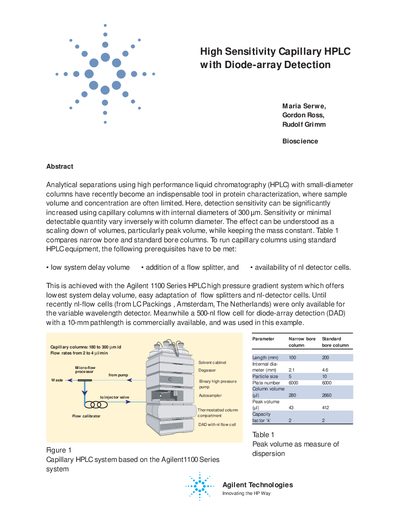
This document describes how to perform high-sensitivity capillary HPLC analysis using the Agilent 1100 Series HPLC high pressure gradient system. It details the prerequisites for running capillary columns, including the need for low system delay volume and specific detector cells.
Read onlineHigh 1100 Series specifications
| Column internal diameter | 180 to 300 µm |
|---|---|
| Flow rates | 2 to 4 µL/min |
| Column length | 100 to 200 mm |
| Flow cell volume | 500 nL |
| Flow cell pathlength | 10 mm |
| Analysis range | femtomole range |
Source: Agilent 1100 Series Capillary HPLC with Diode-Array Detection Application Note
All High 1100 Series documents by type
How to use the product for one specific task, with worked examples.
Questions answered in these manuals
What prerequisites are needed to run capillary columns on standard HPLC equipment?
The system requires low system delay volume, the addition of a flow splitter, and the availability of nL detector cells.
From: Agilent 1100 Series Capillary HPLC with Diode-Array Detection Application Note
What is the advantage of diode-array detection for peptide identification?
It allows spectra of eluting compounds to be stored digitally and manipulated by algorithms, which is useful for identifying peptides with aromatic amino acids.
From: Agilent 1100 Series Capillary HPLC with Diode-Array Detection Application Note
What is the retention time repeatability (RSD)?
The retention time repeatability achieved is less than 0.5% RSD.
What flow rate was used for the peptide separations shown in the document?
The peptide separations were performed using a flow rate of 5.5 uL/min.