
Zemic H10J load cell application guideline covering installation types, mounting styles, accuracy, and frame preparation for truck and trailer weighing.
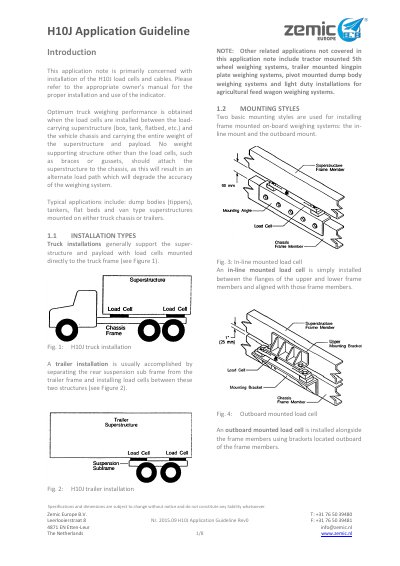
This Zemic H10J application guideline covers the installation of H10J load cells and cables for on-board truck and trailer weighing systems. It describes typical applications such as dump bodies, tankers, flat beds and van type superstructures mounted on truck chassis or trailers.
The document explains in-line and outboard mounting styles, accuracy and performance factors, superstructure preparation, frame stiffeners, recess mounting, alignment, mounting structure, and bolting requirements for load cell brackets.
| Maximum speed at rated capacity | greater than 8 kmph (5 mph) |
|---|---|
| Load cell distance from superstructure end | within 1 m (3 ft) |
| Mounting bracket thickness | usually 16mm (5/8") thick steel |
The in-line mount and the outboard mount.
Approximately 90 mm (3½") unless the frame is recessed.
Within 1 m (3 ft), if possible, to avoid overhanging loads.