
User manual for a wire-free 433 MHz wireless IR barrier covering installation, alignment, DIP settings, specifications and troubleshooting.
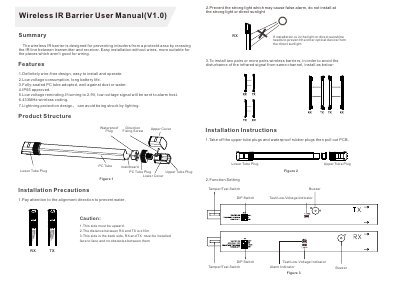
The Wireless IR Barrier User Manual (V1.0) describes a wire-free infrared barrier designed to prevent intruders from crossing the IR line between a transmitter and receiver. It covers features, product structure, installation precautions, installation instructions and function settings.
The manual explains DIP switch settings for anti-tamper, detection power and alarm/interruption periods, plus coding to an alarm host and troubleshooting. It lists maximum detection distance, beam count, working current, battery life, wireless frequency, transmission distance and IP65 rating.
| Maximum detection distance | 10 m |
|---|---|
| Beams | 4 |
| Working mode | 3 options (interruption of all 4 beams or upper 2 beams or below 2 beams) |
| Alarm current | 0.3 mA |
| Battery life | 3 years |
| Wireless frequency | 433 MHz |
| Wireless transmission distance | 100 m in open area |
| Working current | RX <100 μA / TX <100 μA |
| Waterproof grade | IP65 |
| Dimensions | 648 mm (L) x 39 mm (W) x 39 mm (H) |
| Battery model | ER14505 lithium |
| Low-voltage reminder threshold | 2.9 V |
The distance between RX and TX must be no more than 10 m.
The barrier uses ER14505 lithium batteries.
The wireless IR barrier is rated IP65.
Do not install the barrier in strong light or direct sunlight, because strong light may cause false alarm.