
This technical guide explains the Vaisala Optimus DGA monitoring system, focusing on its patented partial vacuum gas extraction method and non-dispersive…
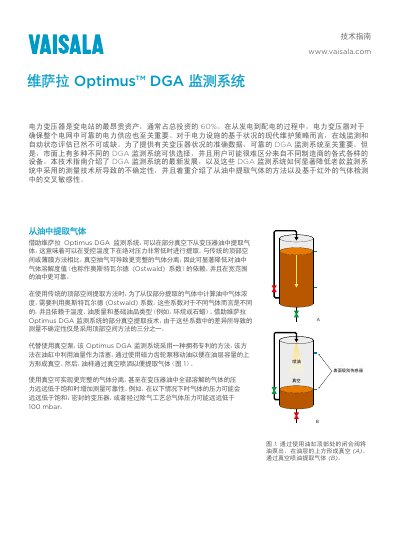
The Vaisala Optimus DGA monitoring system utilizes a patented partial vacuum extraction method to separate gases from transformer oil. Unlike traditional methods relying on Ostwald coefficients, this system uses oil volume as a piston to create a vacuum, ensuring more complete gas separation and reducing measurement uncertainty. The process involves pumping oil out of the cylinder to form a vacuum above the oil layer, followed by vacuum spraying to extract the gas.
For gas analysis, the system employs non-dispersive infrared (NDIR) technology. Gas molecules absorb specific wavelengths of infrared light, creating a unique 'fingerprint' for each component. The Optimus DGA system uses a temperature-controlled IR module with MEMS components to analyze absorption peaks. To ensure long-term stability without recalibration, the system uses the vacuum phase as a reference measurement to compensate for sensor drift and automatically calculates the relative proportion of interfering hydrocarbons to correct the analysis. This manual is written in Chinese.
The system can extract gas when the total gas pressure is far below 100 mbar, such as in sealed transformers or after degassing.
Vacuum is used as a reference measurement during each oil sampling cycle, and the ratio of the two scan signals defines actual absorption and gas concentration.
It calculates the relative proportion of interfering gases and subtracts them from the actual measurement signal.
The first automatic calibration run starts immediately after installation so the system learns the hydrocarbon and VOC mixture in the oil.