
The TRIONS TQXJ-D series sensor manual provides an overview, specifications, wiring and installation instructions for the high‑precision 2‑axis tilt angle…
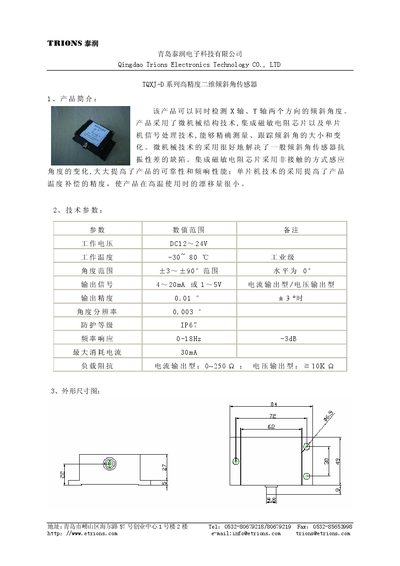
The TQXJ-D series is a high‑precision two‑dimensional tilt angle sensor that measures X‑ and Y‑axis inclination using micro‑mechanical structure, an integrated magnetoresistive chip and MCU signal processing. It offers high accuracy, vibration resistance, and temperature‑compensated performance.
The manual includes a product overview, technical specifications, mechanical drawing, signal‑position relationship, model description, and detailed installation and wiring instructions, including connector pinout and horizontal mounting procedure. This manual is written in Chinese.
| Working Voltage | DC12–24 V |
|---|---|
| Working Temperature | -30 °C to 80 °C |
| Angle Range | ±3° to ±90° |
| Output Signal | 4–20 mA or 1–5 V |
| Output Accuracy | 0.01° ± 3° |
| Angle Resolution | 0.003° |
| Protection Rating | IP67 |
| Frequency Response | 0–18 Hz (-3 dB) |
| Maximum Current Consumption | 30 mA |
| Load Impedance | Current output: 0–250 Ω; Voltage output: ≥10 kΩ |
Connect terminal 1 (red) to the positive power supply, terminal 2 (black) to ground, terminal 3 (yellow) to the X‑axis output signal, and terminal 4 (blue) to the Y‑axis output signal.
Fix the sensor with screws to the measured plane, ensure the rotation axis is perpendicular to the sensor base, and adjust the plane until the output signal is at the mid‑range (12 mA for current output or 3 V for voltage output).
The sensor operates from –30 °C up to 80 °C.