
User manual for the Testo 610 humidity/temperature measuring instrument, covering settings, operation, maintenance and technical data.
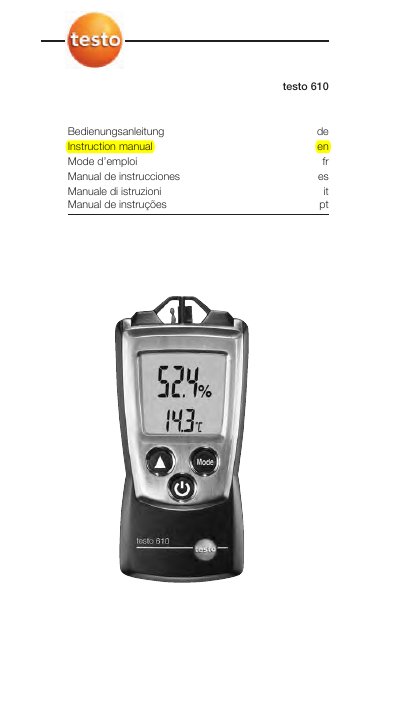
This instruction manual covers the testo 610, a humidity/temperature measuring instrument from Testo that is normally used to measure humidity in offices and storerooms, buildings and greenhouses. It explains the protection cap, humidity/temperature sensor, display, control keys and battery compartment, and walks through first steps such as inserting batteries and setting the temperature unit and auto-off function.
The manual then describes using the product: switching the instrument and display light on and off, changing between % relative humidity, dew point temperature (td) and wet bulb temperature (wb), and switching between current reading, Hold, Max and Min views. It also covers battery changes and cleaning the housing, plus specifications such as measuring ranges, accuracy, protection class IP20, dimensions and weight, and a questions-and-answers section for Hi/Lo readings.
| Sensors | Testo humidity sensor, NTC temperature sensor |
|---|---|
| Parameters | °C, °F, %rH, wet bulb, td |
| Measuring ranges | -10...50 °C, 14...122 °F, 0...100 %rH |
| Resolution | 0.1 °C, 0.1 °F, 0.1 %rH |
| Accuracy (at 25 °C, ±1 digit) | ±0.5 °C, ±0.9 °F, ±2.5 %rH (5...95 %rH) |
| Measuring rate | 1.0 s |
| Protection class | IP20 |
| Ambient conditions | -10...50 °C, 14...122 °F |
| Storage/transport conditions | -40...70 °C, -40...158 °F |
| Voltage supply | 2x 1.5 V type AAA |
| Battery life | 200 h (without display light) |
| Dimensions | 119x46x25 mm (inc. protection cap) |
| Weight | 90 g (inc. batteries and protection cap) |
| Warranty | 2 years |
It measures from -10 to 50 °C (14 to 122 °F) and from 0 to 100 %rH.
Battery life is 200 hours without the display light, using two 1.5 V type AAA batteries.
The readings are outside the measuring range (too high or too low); keep to the permitted measuring range.
Push the battery cover down to open the compartment, insert two 1.5 V type AAA batteries observing the polarity, then push the cover back on.