
Instruction manual for the Testo 316-EX gas leak detector, covering safety, specifications, setup, operation, maintenance, and troubleshooting.
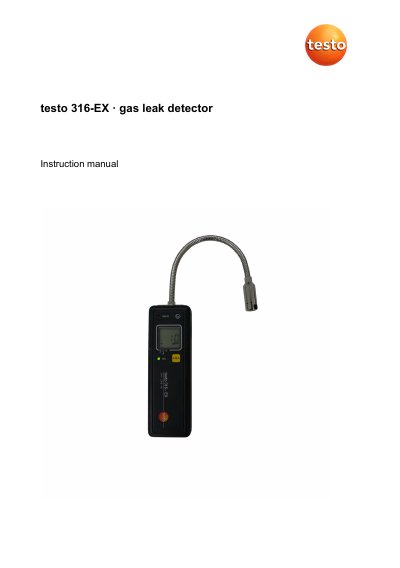
The Testo 316-EX is a gas leak detector for short-term detection of gases in areas at risk of explosion according to Directive 94/9/EC (ATEX). It is intended for gas detection in rooms and locating leaks at gas systems, and is designed for use by trained personnel.
The manual covers safety and environmental precautions, technical data, product description, commissioning, settings, operation, maintenance, and troubleshooting. The document also lists approved batteries and spare parts.
| Sensor type | Semi-conductor |
|---|---|
| Response threshold | 1 ppm |
| Reaction time (t90) | 14 s |
| Measuring range - Methane CH4 | 0 ppm up to 2.5 vol% |
| Measuring range - Propane C3H8 | 0 ppm up to 1.0 vol% |
| Measuring range - Hydrogen H2 | 0 ppm up to 2.0 vol% |
| Power supply | 2 x 1.5 V mignon/AA |
| Battery life | approx. 6 h (typical) |
| Operating conditions | -10 to 40 °C / 14 to 104 °F, 20 to 80 % RH not condensing |
| Weight | approx. 200 g/0.44 lb. (incl. battery) |
| Dimensions (L x W x H) - Housing | approx. 135 x 45 x 25 mm / 5.31 x 1.77 x 0.99" |
| Sensor shaft length | approx. 200 mm/7.87" |
| Protection class | IP54 |
| Warranty | 2 years |
| ATEX instrument labelling | 1258 II 2 G Ex ib IIC T1 |
It is used for short-term detection of gases in areas at risk of explosion, including gas detection in rooms and locating leaks at gas systems.
No. The instrument is not protective equipment and must not be used as a monitoring instrument for personal safety or as a gas analyzer.
Switch it on only in fresh air, because automatic zeroing is performed at the end of the warm-up time. The ambient temperature during zeroing should match the temperature at the measuring location.
Leave the instrument switched on until the zero point stabilizes, which can take up to 45 minutes. Contamination from oxidation during long periods of non-use is a possible cause.