
This guide covers the application of the Philips TJA1020 LIN transceiver, including operating modes, slave/master configurations, EMC aspects, and fault…
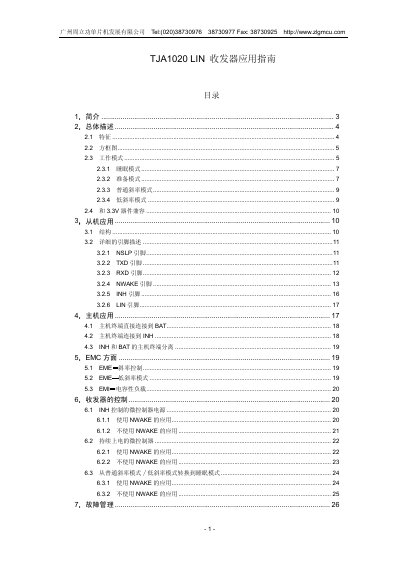
This document serves as an application guide for the Philips TJA1020 LIN transceiver, focusing on its implementation as a physical media attachment in LIN electronic control units (ECUs). It details the device's characteristics, including support for baud rates up to 20kBaud and compatibility with 3.3V devices.
The guide provides technical descriptions of the four operating modes: Sleep, Standby, Normal Slope, and Low Slope. It also covers specific application configurations for both slave and master nodes, EMC considerations such as EME slope control, and fault management strategies for scenarios like LIN bus-to-ground shorts. This manual is written in Chinese.
| Maximum Baud Rate | 20kBaud |
|---|---|
| Maximum Nodes | 16 |
| Operating Voltage Range | 5V to 27V |
| Low Slope Mode Threshold | <10kBaud |
The TJA1020 is suitable for LIN transmission rates up to 20kBaud.
The network can support up to 16 nodes.
The device supports a battery voltage range from 5V to 27V.