
This Polish user manual provides safety instructions, operating procedures, troubleshooting guides, and technical specifications for the Philips 160E1 LCD…
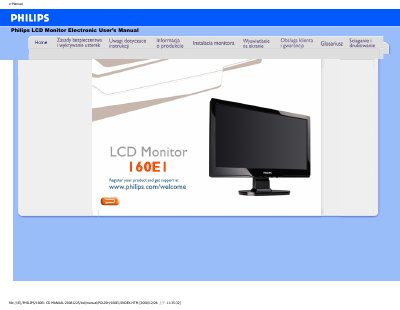
This document serves as the electronic user's manual for the Philips 160E1 LCD monitor. It contains essential safety warnings, operational instructions, and guidance on maintaining the device to ensure optimal performance and longevity. The manual emphasizes proper handling, such as avoiding direct sunlight and using approved power cords, and details how to clean the screen without damaging the protective coating. This manual is written in Polish.
| Operating Temperature | 0 - 40°C (32 - 104°F) |
|---|---|
| Operating Humidity | 20 - 80% RH |
| Recommended Video Mode | 1366 x 768 @60Hz |
Set the resolution to 1366 x 768 pixels and the refresh rate to 60 Hz in the Windows Display properties.
No, LCD monitors display a stable, non-flickering image at 60 Hz, and there are no visible differences between 85 Hz and 60 Hz.
Yes, the monitor has four standard VESA mounting holes on the back cover for wall mounting.
Use a clean, soft cloth for normal cleaning. For stubborn dirt, isopropyl alcohol may be used, but never organic solvents like ethyl alcohol or acetone.