
Instruction manual for the Oakton 35660-58 conductivity electrode: specifications, connection, cell constant setting, measurement, maintenance and storage.
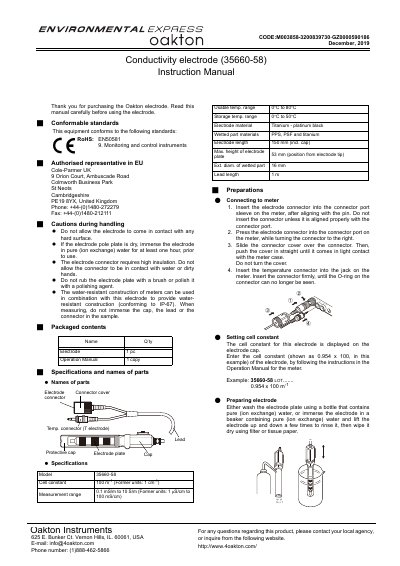
The Oakton 35660-58 is a conductivity electrode with a titanium-platinum black electrode plate and a 1 m lead. The manual states the cell constant, measurement range, usable and storage temperature ranges, wetted materials and dimensions, and lists the packaged contents.
The document gives handling cautions and instructions for connecting the electrode to a meter, setting the cell constant, preparing the electrode, taking measurements, cleaning and storage. It also includes notes on measuring low-conductivity samples and on maintenance with a neutral cleansing agent or 5% nitric acid.
| Model | 35660-58 |
|---|---|
| Cell constant | 100 m-1 (Former units: 1 cm-1) |
| Measurement range | 0.1 mS/m to 10 S/m (Former units: 1 μS/cm to 100 mS/cm) |
| Usable temp. range | 0 °C to 80 °C |
| Storage temp. range | 0 °C to 50 °C |
| Electrode material | Titanium - platinum black |
| Wetted part materials | PPS, PSF and titanium |
| Electrode length | 150 mm (incl. cap) |
| Ext. diam. of wetted part | 16 mm |
| Lead length | 1 m |
The cell constant is shown on the electrode cap; enter it by following the meter's Operation Manual. The example in the manual is 0.954 x 100 m-1.
Immerse the electrode in pure (ion exchange) water for at least one hour before use.
For long-term use, the manual recommends measuring the cell constant once every two or three months.
Store it indoors, out of direct sunlight, and avoid hot or high-humidity places.