
Quick Start Guide for the Nautilus GPS Marine Rescue device, covering activation, operation, testing, battery replacement, antenna rewinding, region…
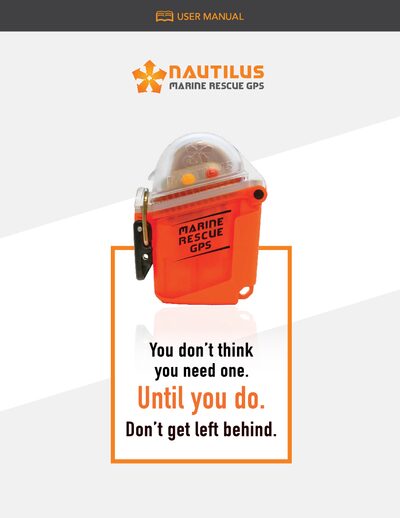
This Quick Start Guide walks users through the essential steps to get the Nautilus GPS Marine Rescue device up and running. It includes instructions for powering on the unit, performing a distress transmission, testing the GPS lock, and using the companion mobile app for region and MMSI programming.
Safety notes remind users that the device is an aid to safety, not a life‑saving device, and provide handling cautions for the antenna retainer, battery replacement, and RF exposure. Technical specifications such as transmit power, frequency bands, operating temperature range and dimensions are listed at the end of the guide.
| AIS Transmit Power | 1 Watt |
|---|---|
| AIS Frequency | 161.975 and 162.025 MHz |
| DSC Transmit Power | 0.5 Watt |
| DSC Frequency | 156.525 MHz |
| Environmental Temperature Range | -20°C ~ +55°C |
| Waterproof Depth | 425 feet (130 meters) |
| Dimensions | 2.9 x 3.8 x 1.5 inch (75 x 97 x 39mm) |
| Weight | 4.6 oz (131g) |
Press and hold the red “H” button for 5 seconds to begin distress transmission.
The Nautilus GPS uses two CR123 3V batteries; replace them with a Philips #1 screwdriver, ensuring the batteries are within the marked expiry date.
Press and hold the Test Button for 5 seconds until the yellow indicator flashes; the device will transmit a single position report after acquiring a GPS lock.