
This user guide covers the operation, safety, testing procedures, and maintenance of the Megger EVCC 300 Electric Vehicle Charger Checker.
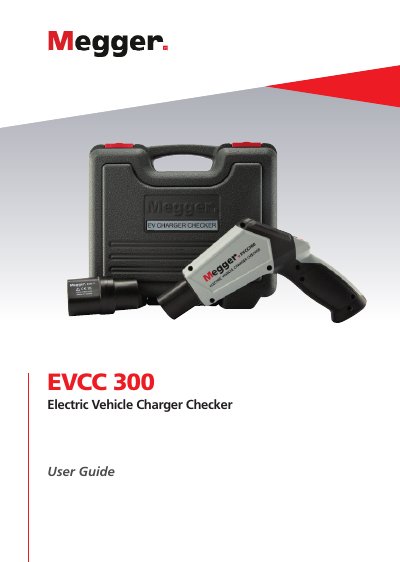
The Megger EVCC 300 is a compact, ergonomically designed instrument that provides a simple, all-in-one solution for checking the safety and operation of single-phase Mode 2 and Mode 3 electric vehicle chargers. It verifies compliance with IEC 61851-1:2017 by simulating control pilot conditions and reading the code received from the charger without needing a separate oscilloscope.
The manual details the instrument's features, including safety checking tests for protective earth integrity and nuisance tripping, as well as operation checking tests for proximity and control pilot signals. It provides step-by-step instructions for setup, performing various tests, interpreting results, and conducting maintenance such as battery replacement.
| Supply Voltage Range | 5 V to 300 V |
|---|---|
| Supply Frequency Range | 45 Hz to 65 Hz |
| RPE Test Current | 200 mA |
| RPE Resistance Range | 0 to 10 Ω |
| CP Frequency Range | 940 Hz to 1040 Hz |
| CP Duty Cycle Range | 8% to 97% |
| Adaptor Connection | Type 1 female - CAT II 300 V |
The instrument checks the safety and operation of single phase mode 3 chargers with type 2 connections and type 1 connections using an adaptor.
No, the equipment is not intrinsically safe and must not be used in hazardous atmospheres.