
The Keli D39 electronic weighing instrument user manual provides technical parameters, operation steps, permission settings, and data storage instructions.
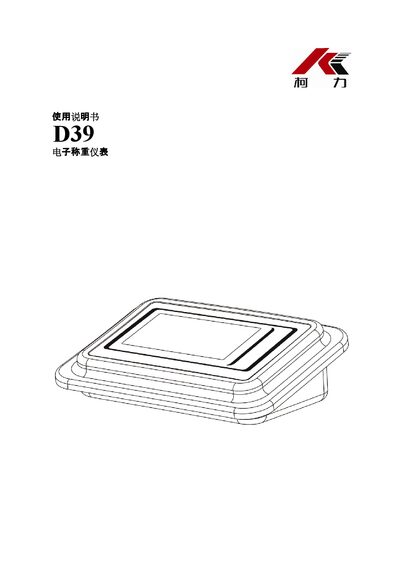
This manual introduces the D39 electronic weighing instrument, covering safety precautions, technical specifications, and environmental requirements. It details the instrument's display, interfaces, power supply, and supported communication protocols.
The guide explains basic operation, including key functions, zeroing, tare handling, and permission configuration. It also describes how to store, query, print, and format weighing records, with examples of weight ticket layouts and printing interface options. This manual is written in Chinese.
| Maximum verification division | n=3000 |
|---|---|
| Error distribution coefficient | π = 0.5 |
| Digital sensor interface | RS485 |
| Display | 7‑inch 800×480 TFT |
| Keyboard | Resistive touch screen |
| Power supply | DC 12–14.8 V |
| Maximum digital sensors | 16 |
| Supported communication protocols | C‑type, E‑type, K‑type |
| Printing interface | Parallel, compatible with EPSON LQ‑300K series printers |
| Data storage capacity | 1000 vehicle tare groups, 4000 latest weight records |
| Operating temperature range | -10 °C to 40 °C |
| Storage temperature range | -25 °C to 55 °C |
| Dimensions (L×W×H) | 318 mm × 218 mm × 100 mm |
| Weight | 2.9 kg |
The instrument can connect up to 16 digital sensors.
A standard parallel printing interface is provided and it is compatible with EPSON LQ‑300K series and other listed printers.
The device operates between –10 °C and 40 °C.