
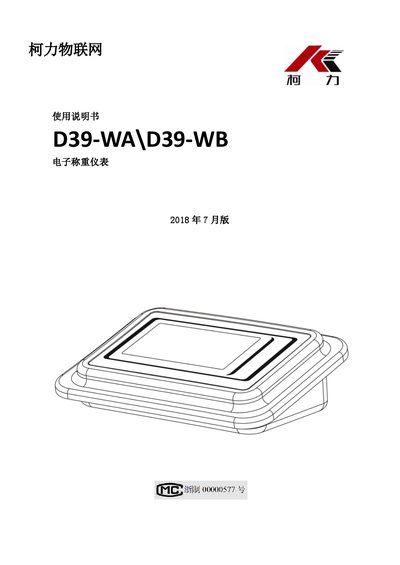
This manual covers the D39-WA and D39-WB series electronic weighing instruments, detailing safety precautions, installation requirements, and proper grounding. It explains the touch‑screen operation, permission modes, and various application functions such as automatic zeroing, tare management, and weight record handling.
Additional sections describe data storage capacity, printing interfaces, Ethernet communication, and print format customization. An appendix provides sample weight slip formats for both standard and custom layouts. This manual is written in Chinese.
| Model | D39-WA series, D39-WB series |
|---|---|
| Maximum verification division | n=6000 |
| Error distribution coefficient | π = 0.5 |
| Digital sensor interface | RS485 |
| Maximum sensor bus length | 30 m with 12 sensors |
| Supported baud rates (RS485) | 9600, 19200 bps |
| Power supply (excitation) | DC 12‑14.8 V |
| Maximum digital sensors | 16 |
| Data storage capacity | 1000 vehicle tare groups, 3500 latest weight records, 300 incomplete records, 6 overload records |
| Operating temperature range | -10 °C ~ 40 °C |
| Storage temperature range | -25 °C ~ 55 °C |
| Maximum relative humidity | ≤85 %RH |
The instrument power ground line must follow electrical safety regulations, and the grounding box and sensor housings must be well grounded.
Up to 16 digital sensors can be connected to the instrument.
The device can store 1000 vehicle tare groups, 3500 latest weight records, 300 incomplete records, and 6 overload records.