
The EPC 220C/230 Encoder User Manual provides specifications, wiring diagrams, and installation instructions for the 220C and 230 series encoders.
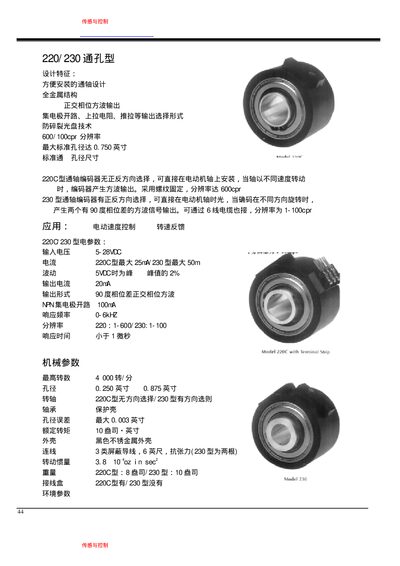
The EPC 220C/230 encoders are through‑shaft, all‑metal devices offering orthogonal quadrature square‑wave outputs. The 220C model provides a fixed direction output, while the 230 model includes forward/reverse selection and a 6‑wire cable option.
The manual lists electrical and mechanical parameters such as input voltage, current limits, resolution, response frequency, maximum speed, and mounting dimensions, and includes wiring diagrams, accessory part numbers, and application guidance for speed feedback in motor control systems.
| Input voltage | 5‑28 VDC |
|---|---|
| Maximum current (220C) | 25 mA |
| Maximum current (230) | 50 mA |
| Resolution | 600 cpr (220C) / 100 cpr (230) |
| Output type | 90° phase‑shift quadrature square wave |
| Response frequency | 0‑6 kHz |
| Response time | < 1 µs |
| Maximum speed | 4000 rpm |
| Shaft bore | 0.250 in |
| Weight | 8 oz (220C) / 10 oz (230) |
It operates from a 5 V to 28 V DC supply.
The 220C model provides up to 600 counts per revolution.
Yes, the 230 model includes forward/reverse direction selection.
They are rated for up to 4000 rpm.