
The Dynisco PT390 oil field pressure transmitter provides a 4 to 20 mA output, 5,000 to 20,000 psi ranges, and NEMA 4X protection for hazardous areas.
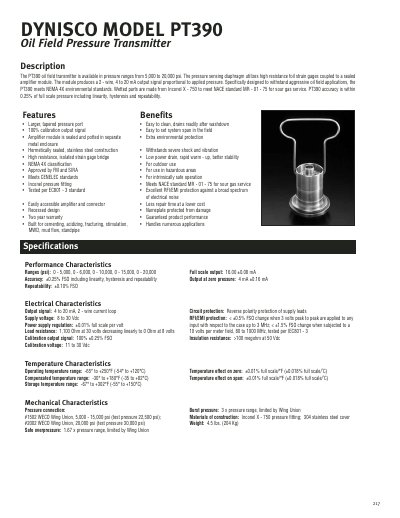
The Dynisco PT390 oil field pressure transmitter is designed for aggressive oil field applications and meets NEMA 4X environmental standards. It uses high resistance foil strain gages coupled to a sealed amplifier module to produce a 2-wire, 4 to 20 mA output signal proportional to applied pressure.
Pressure ranges span 5,000 to 20,000 psi with accuracy within 0.25% of full scale. Wetted parts are made from Inconel X-750 to meet NACE standard MR-01-75 for sour gas service, and the unit is approved by FM and SIRA for use in hazardous areas.
| Pressure range | 0 - 5,000 to 0 - 20,000 psi |
|---|---|
| Output signal | 4 to 20 mA, 2-wire current loop |
| Accuracy | ±0.25% FSO |
| Supply voltage | 8 to 30 Vdc |
| Operating temperature | -65° to +250°F (-54° to +120°C) |
| Weight | 4.5 lbs. (204 Kg) |
It uses a 4 to 20 mA, 2-wire current loop output signal.
Ranges run from 5,000 to 20,000 psi.
Yes, it is approved by FM and SIRA for use in hazardous areas.
Accuracy is within ±0.25% of full scale including linearity, hysteresis and repeatability.