
The Dell EMC Z9100-ON spec sheet details the high‑density 10/25/40/50/100 GbE fixed switch’s features, performance and technical specifications.
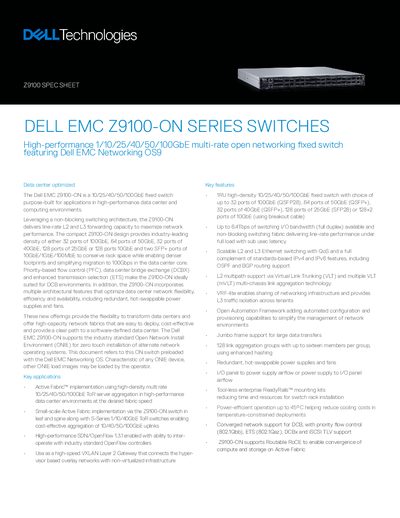
The Dell EMC Z9100-ON is a 10/25/40/50/100 GbE fixed switch designed for high‑performance data‑center environments. It offers non‑blocking architecture, up to 6.4 Tbps of switching I/O bandwidth, and supports ONIE for zero‑touch installation of alternate network operating systems.
Physically the unit is a 1‑RU chassis (1.72"h × 17.1"w × 18"d) weighing 22 lb, with two hot‑swappable power supplies and fans. It meets multiple regulatory standards (UL, CE, FCC, RoHS) and includes extensive Layer 2/3 features, QoS, and security capabilities.
| Switching I/O bandwidth | 6.4 Tbps (full duplex) |
|---|---|
| Maximum power consumption | 605 Watts |
| Dimensions | 1 RU, 1.72"h × 17.1"w × 18"d |
| Weight | 22 lbs (9.98 kg) |
| Port density (100GbE) | Up to 32 ports of 100GbE (QSFP28) |
| Latency | Sub 500 ns |
The switch provides up to 6.4 Tbps of switching I/O bandwidth in full‑duplex mode.
It includes two hot‑swappable power supplies.
The unit operates from 32 °F to 113 °F (0 °C to 45 °C).
Yes, it supports the Open Network Install Environment (ONIE).