
Selection guide for Danfoss VACON 20 compact AC drives, including standard and Cold Plate versions for power ranges from 0.25 kW to 18.5 kW.
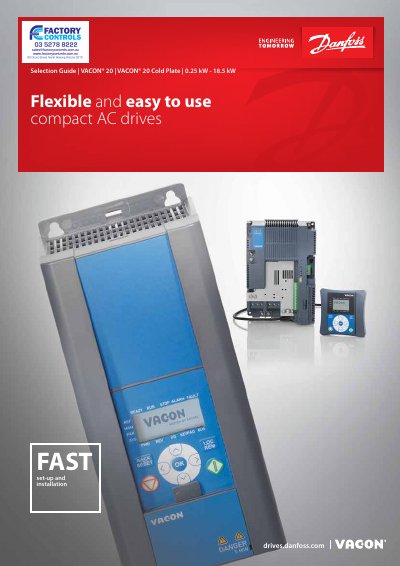
The VACON 20 is a compact AC drive designed for efficient volume manufacturing, offering a wide power range from 0.25 kW to 18.5 kW and supporting voltages from 105-600 V. It features built-in PLC functionality based on IEC61131-3, an RS485 interface, and support for induction and permanent magnet (PM) motors.
Additionally, the VACON 20 Cold Plate version provides enhanced cooling flexibility for demanding environments, allowing for passive cooling via heat sinks or liquid cooling. This version is suitable for high-dust or high-moisture environments due to its ability to be installed in compact sealed enclosures.
| Power Range | 0.25 kW - 18.5 kW |
|---|---|
| Supply Voltage | 105-600 V |
| PLC Standard | IEC61131-3 |
| Fieldbus Support | CANOpen, DeviceNet and PROFIBUS DP |
| Cold Plate Ambient Temperature | up to 70 °C |
Typical applications include pumps, fans, conveyors, and packaging, processing, and washing machines.
The MCA (Micro Communications Adapter) allows for parameter copying without main power in the drive.
It allows for flexible cooling using various media like liquid or heat sinks, enabling installation in sealed enclosures for dusty or moist environments.