
The Chint NJR2-G one-use-one-backup soft starter control cabinet provides automatic switchover between two motors with overload, overcurrent, phase‑loss…
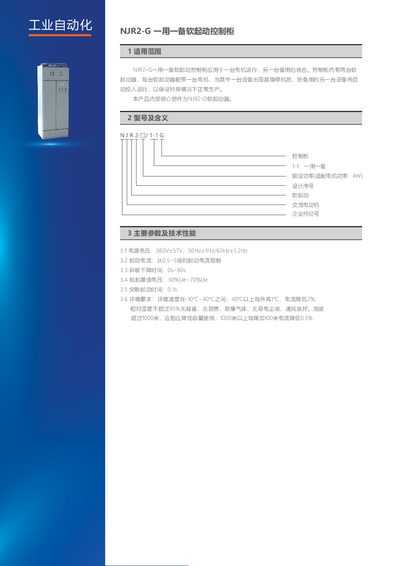
The NJR2‑G control cabinet is designed for industrial automation where one motor operates while a second motor serves as a standby. Each cabinet houses two soft starters, each paired with a motor, and automatically switches to the standby motor if a fault occurs, ensuring continuous production. The core component is the NJR2‑D soft starter.
Key features include overload, overcurrent, phase‑loss, over‑voltage and undervoltage protection, copper‑bus connections for improved electrical performance, a three‑dimensional layout for easier installation and debugging, and fault display with memory function. Technical parameters such as supply voltage, start current limits, ramp‑down time, and environmental requirements are detailed in the manual. This manual is written in Chinese.
| Supply voltage | 380 V±57V; 50Hz±1Hz/60Hz±1.2Hz |
|---|---|
| Starting current limit | 0.5~5 times the rated start current |
| Ramp‑down time | 0 s ~ 60 s |
| Soft‑start base voltage | 30 % Ue ~ 70 % Ue |
| Jump‑start time | 0.1 s |
| Operating temperature range | -10 °C ~ 40 °C |
| Maximum relative humidity | ≤95 % (no condensation) |
| Altitude derating | Reduce current 0.5 % per 100 m above 1000 m |
The cabinet is rated for 380 V ± 57 V with a frequency of 50 Hz ± 1 Hz or 60 Hz ± 1.2 Hz.
If one motor stops due to a fault, the standby motor automatically starts to maintain production.