
A selection guide for BrightKing Transient Voltage Suppressors covering working principles, characteristics, naming rules, electrical testing methods, and…
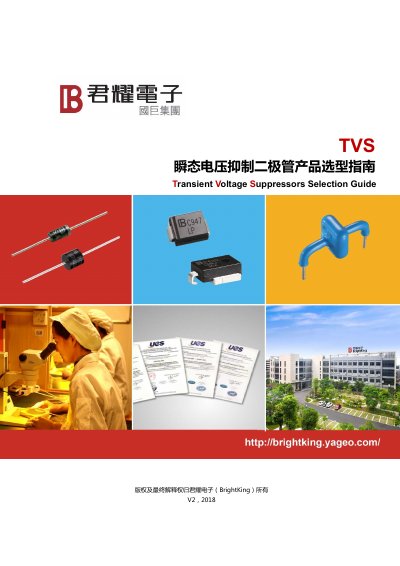
This document serves as a comprehensive selection guide for BrightKing's Transient Voltage Suppressors (TVS). It details the operating principles of TVS devices, distinguishing between unidirectional and bidirectional types, and explains their key features such as low dynamic internal resistance and fast response speeds. The guide also lists various available package forms including SOD-123, SMA, SMB, SMC, and DO series. This manual is written in Chinese.
| Package Types (SMD) | SOD-123, SMA, SMB, SMC |
|---|---|
| Package Types (Through-hole) | DO-41, DO-15, DO-201, P-600 |
| Transient Power Range (10/1000μs) | 200W~30000W |
| Operating Voltage Range | 3.3V~600V |
Unidirectional TVS are generally applied in DC power supply circuits, while bidirectional TVS are used in circuits with alternating voltage.
The breakdown voltage generally has a deviation of ±5%, though higher precision can be achieved through process improvement or parameter screening.